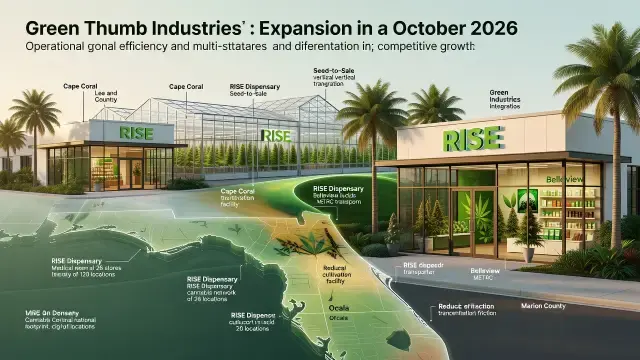
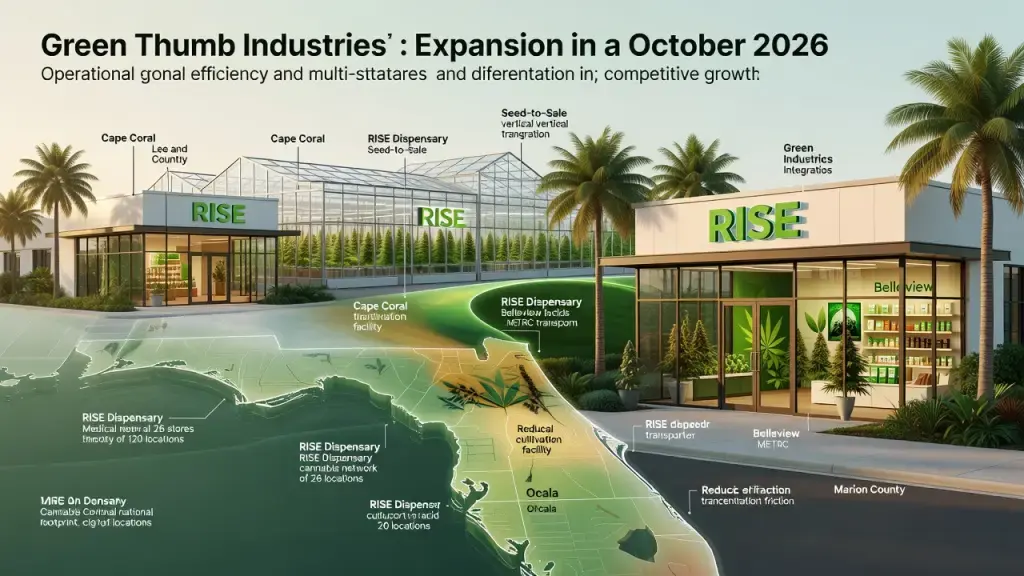
Green Thumb Industries opened RISE Dispensary Cape Coral and RISE Dispensary Belleview in October 2026, pushing its Florida store count to 26 within a national network topping 120 locations. The additions land in Lee and Marion counties, two markets where the company already has cultivation and brand infrastructure in place, which matters more than the headline store count suggests.
Why These Two Stores Are Not Just Square Footage
Here's the catch with retail expansion in cannabis: a new storefront only generates durable value if it connects to something upstream. The Belleview opening, which came online October 16, ties directly into Green Thumb's Ocala cultivation and production facility. That's a seed-to-sale relationship in the literal sense - flower, concentrates and finished goods move from a known production node into a dispensary a short drive away, rather than relying on third-party wholesale or long-haul transport across Florida's medical market. For an operator managing compliant packaging, batch tracking and METRC reporting across two dozen stores, proximity between cultivation and retail reduces friction in inventory management and lowers the odds of stockouts on in-house SKUs. Cape Coral extends that same logic into Lee County, giving the company another point of contact with Florida's medical patient base while reinforcing the in-house brand portfolio that differentiates vertically integrated multi-state operators from single-state retailers leaning on third-party supply.
What This Means for the Investment Narrative
To own Green Thumb Industries as an equity, the working assumption has to be that measured store growth across its footprint eventually converts into durable cash generation, even with sector headwinds pressing on margins. The Florida build-out supports that operational case in a meaningful medical market. It does not, however, rewrite the near-term story. That story still hinges on execution quality, pricing discipline, and consumer demand holding up in core states - Florida included.
Analyst models currently point to roughly $1.5 billion in revenue and $79.6 million in earnings by 2029, built on an assumed 6.6% annual growth rate. Worth sitting with: that earnings figure is actually a decline from today's $126.8 million, a drop of roughly $47 million rather than the increase investors might expect from continued store openings. The more bearish scenarios modeled in the market assume closer to $1.4 billion in revenue and $49.1 million in earnings by the same year, built on flat near-term revenue and rising SG&A as the dominant force. New dispensaries, in other words, are not automatically a profitability story. They're a distribution story that still has to clear a cost structure that's been getting heavier.
The Swing Factors Operators and Investors Should Track
Price compression remains the persistent risk across Florida and most mature medical and adult-use markets. As license counts grow and competition intensifies, average unit prices tend to slide even when unit volume holds steady, which squeezes margin on exactly the kind of in-house brand sales these new stores are built to drive. Layered onto that is 280E - the federal tax provision that disallows standard business deductions for plant-touching cannabis companies - which keeps effective tax burdens elevated regardless of how efficiently a retailer runs its POS terminals or manages wholesale menus.
That's why federal rescheduling sits at the center of the bull case. A shift in cannabis's scheduling status, and any accompanying tax relief, would directly ease the 280E burden and free up cash that currently gets absorbed by federal tax bills rather than reinvested in stores, cultivation capacity, or compliance infrastructure. Until that happens, companies are left optimizing around the margins: tighter inventory control, disciplined SG&A, and selective expansion into markets like Florida, Minnesota, and prospectively Virginia, where regulatory trajectory looks more favorable. Cape Coral and Belleview fit that playbook. Whether they move the five-year earnings outlook depends less on the ribbon-cutting and more on what happens with federal policy and pricing over the next several quarters.