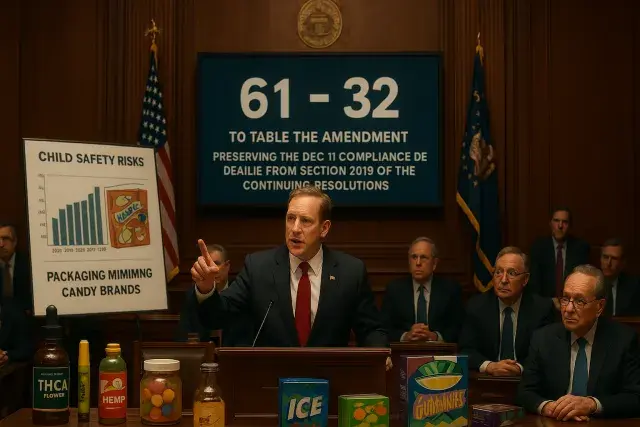
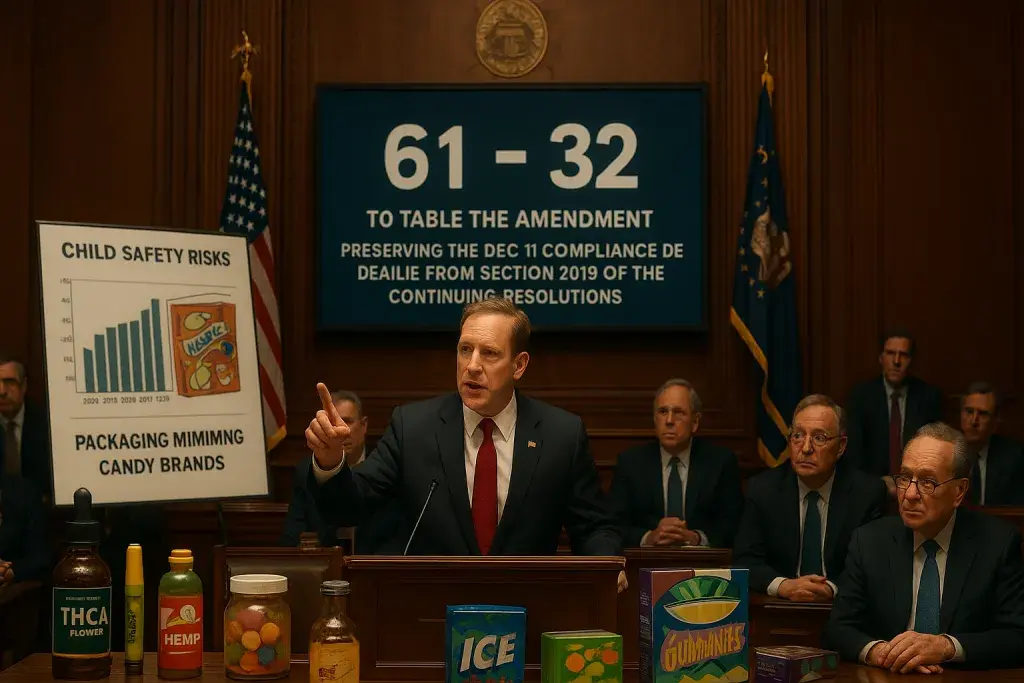
A one-month reprieve for intoxicating hemp retailers survived a Senate floor fight last week, after senators voted 61-32 to table an amendment from Sen. Ted Budd, R-NC, that would have kept the federal hemp restrictions on their original Nov. 12 effective date. The vote preserves Section 2019 of the continuing resolution, which pushes the compliance deadline to Dec. 11 - a narrow but consequential window for an industry that has spent the past year bracing for a total THC standard that could wipe out a large share of its retail shelf space.
For operators selling hemp-derived beverages, gummies, vapes, and THCA flower, the stakes are not abstract. The underlying law, passed in November 2025, redefines hemp based on total THC content and bars finished products containing more than 0.4 milligrams of combined THC and similar cannabinoids per container. That threshold is far stricter than what most state hemp markets currently allow, meaning a large swath of existing SKUs would become non-compliant overnight once the rule takes effect. Retailers straddling adult-use cannabis and hemp categories are watching this closely, since inventory systems built around one compliance standard don't automatically adjust to another - a reality that has pushed some multi-state operators toward platforms offering compliant cannabis POS in Ontario and other regulated markets as they prepare for cross-border product segmentation and tighter SKU-level tracking. compliant cannabis POS in Ontario
Why the Delay Became a Flashpoint
Budd framed his amendment around child safety, citing packaging that mimics snack and candy brands and North Carolina emergency-room data showing a steep rise in cannabis-related visits among minors between 2017 and 2025. His argument, delivered on the Senate floor, was straightforward: Congress voted to close what he called the hemp loophole nine months ago, and further delay simply extends the period during which unregulated intoxicating products remain available in convenience stores and gas stations.
The opposition told a different story. A coalition of 105 organizations, including the US Hemp Roundtable, the National Association of Convenience Stores, and several North Carolina trade groups, argued that a 30-day extension gives Congress room to build actual regulation - age limits, testing protocols, labeling standards, and restrictions on synthetic cannabinoid imports - rather than triggering a blunt-force market shutdown. That's the tension running through this entire debate: a strict THC cutoff is easy to legislate but hard to enforce cleanly, while a regulatory framework takes longer to write but arguably does more to address the packaging and marketing practices Budd is worried about.
A Split Inside the Party, and a Call From the White House
The disagreement wasn't confined to floor votes. Reports of a tense closed-door Senate Republican lunch, where Budd, Sen. Pete Ricketts, and Sen. Tom Cotton pressed for the original deadline while a White House aide made clear no further extension was coming, show how unsettled this issue remains even within one party. President Trump's direct call to Budd, and CMS Administrator Dr. Mehmet Oz's public letter warning that the restrictions could disrupt hemp-derived CBD access for seniors and people with disabilities, underscore that this is no longer a niche compliance question - it has become a genuine policy dispute with competing constituencies on both sides.
North Carolina's Parallel Deadlock
The federal fight has a direct state-level echo. North Carolina's House Bill 328 would import the same 0.4-milligram threshold into state law, independent of whatever Congress ultimately does. The Senate passed the conference report 37-6 back in July, but the House has left it sitting in the Rules Committee. House Speaker Destin Hall has acknowledged the current market can't continue unregulated, but lawmakers remain split on whether prohibition-by-threshold or a broader licensing and testing regime is the better fix. For hemp retailers and wholesalers operating compliance logs and product batches around a moving legal target, that uncertainty is arguably more disruptive than the substance of either proposal.