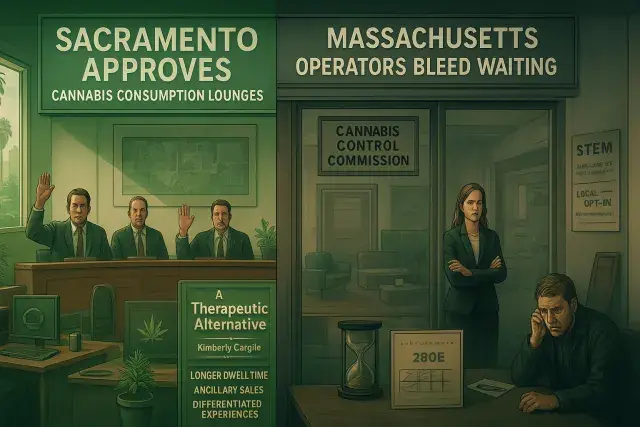
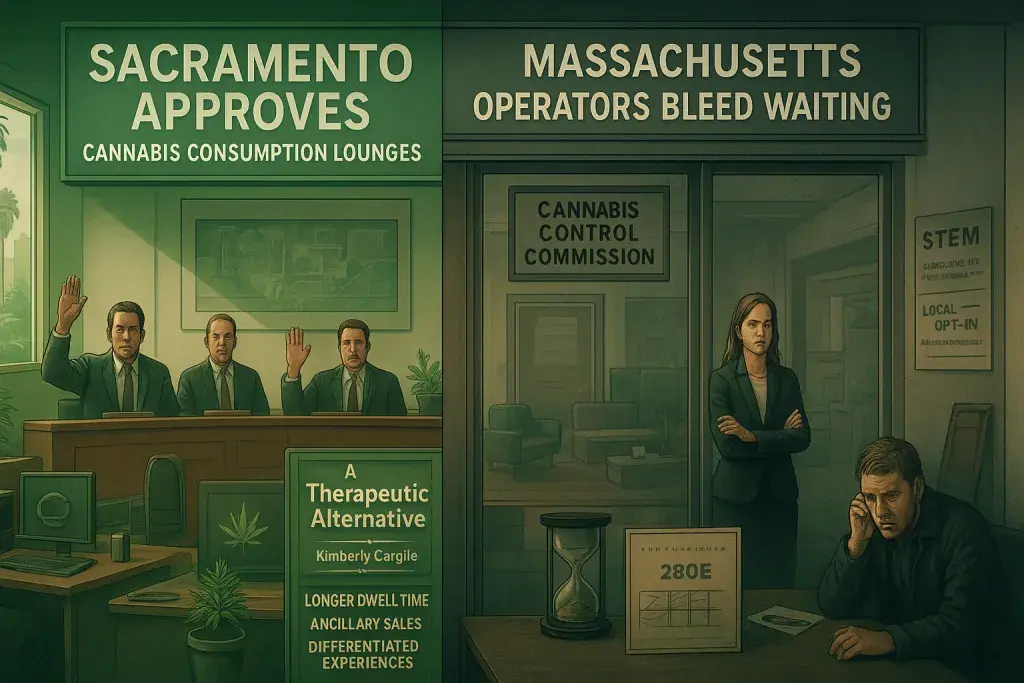
Sacramento's city council voted Tuesday to launch a five-year pilot program permitting on-site cannabis consumption lounges at licensed retailers - a structural shift that gives operators in California's capital city a legal framework they've lobbied for since adult-use legalization. The vote makes Sacramento one of the more prominent California municipalities to formalize a lounge licensing tier, and it comes as the broader question of where consumers can legally consume cannabis remains largely unresolved across regulated markets. Meanwhile, in Massachusetts, entrepreneurs have sunk significant capital into lounge buildouts they still cannot legally open.
The Sacramento program establishes two distinct license categories. Type 1 permits cover nonsmoking consumption - edibles, infused beverages - at a permit fee of $7,238. Type 2 permits allow smoking and vaping in specially ventilated spaces, with a fee of $9,651. Both tiers apply to existing licensed cannabis retailers. The five-year pilot framing is deliberate: city leaders want operational data before committing to a permanent licensing structure. Applications are expected to open next month. For operators tracking how other regulated markets are building out consumption infrastructure and retail licensing frameworks, resources like learn more can offer useful comparative context on how different states approach retail cannabis licensing layers. The fee structure in Sacramento is already drawing scrutiny - Kimberly Cargile, owner of A Therapeutic Alternative, told local outlet KCRA that the costs represent a genuine barrier for small businesses, social equity licensees, and women-owned operations, a concern that tracks with a pattern seen across regulated markets where compliance costs compound fastest for independent operators.
What's striking here is the gap the lounge model is trying to close. As Mindy Galloway of The Pocket Dispensary put it plainly to KCRA: consumers can't smoke in parks, can't smoke on the street, and in many cases can't smoke in apartments. Legal adult-use markets created the right to purchase cannabis but largely failed to create legal spaces to consume it - an awkward policy gap that lounges are designed to fill. For retailers, a lounge attached to a licensed dispensary is also a potential revenue layer: longer dwell time, potential ancillary sales, and a differentiated in-store experience. The operational burden, though, is real. Type 2 ventilation requirements, staff training for on-site consumption, and liability management add complexity that not every retailer is positioned to absorb on top of existing compliance obligations.
Massachusetts Shows What Stalled Rollout Actually Costs
Sacramento's forward motion makes the Massachusetts situation look sharper by contrast. The state's Cannabis Control Commission approved social consumption regulations in December 2025 - but six months later, the licensing infrastructure still isn't open. The CCC's Social Consumption Regulatory Implementation Project, launched in January, has four working groups still in planning: drafting municipal opt-in templates, mapping licensing steps, and building the administrative architecture cities and towns need before a single application can be filed. Every municipality must affirmatively opt in through a local ordinance, bylaw, or vote. Almost none have done so.
The cost to operators waiting on that machinery is not abstract. Caroline Pineau, owner of retail shop Stem, has invested $2 million in renovations to convert a floor of her dispensary into a lounge. That capital is deployed. The revenue is not. In cannabis retail, where operators already carry the weight of 280E federal tax treatment - which disallows standard business deductions for federally controlled substances - cash flow pressure is structurally harder to absorb than in most other retail categories. Carrying renovation debt on a space generating zero revenue while fixed costs accrue is a genuine business risk, not a minor inconvenience. "Every single day that we miss out on opening our doors to social consumption it is a detriment to our business," Pineau told The Boston Globe. That's not rhetoric. That's a cash flow statement.
The Licensing Architecture Problem Is the Real Story
Both markets illustrate the same underlying tension: consumption lounge policy sounds manageable in regulatory documents and becomes operationally complicated the moment it touches local zoning, permitting timelines, and small-business finance. Sacramento chose a pilot structure with tiered licensing and defined fees - imperfect, but functional. Massachusetts chose a framework that routes approval through individual municipalities, each of which must act independently, creating a fragmented opt-in process that can stall indefinitely at the local level without any single point of accountability.
For multi-location operators, cannabis real estate investors, and vendors supplying POS systems, ventilation equipment, or compliance software to the lounge market, the lesson is consistent: the regulatory pathway to opening matters as much as the license category itself. A lounge license that exists on paper but requires six layers of municipal action before the first application is processed is not an open market - it's a queue with no published wait time. Operators considering lounge buildouts in any state should map the full approval chain before committing capital: state regulations, local opt-in requirements, zoning compatibility, ventilation code compliance, and inspection timelines. Sacramento's pilot at least gives applicants a defined next step. In Massachusetts, that step is still being built.