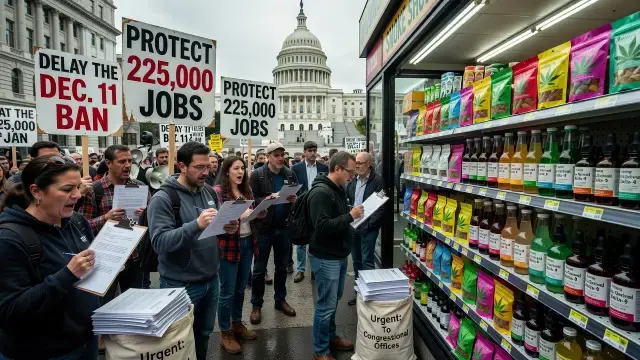
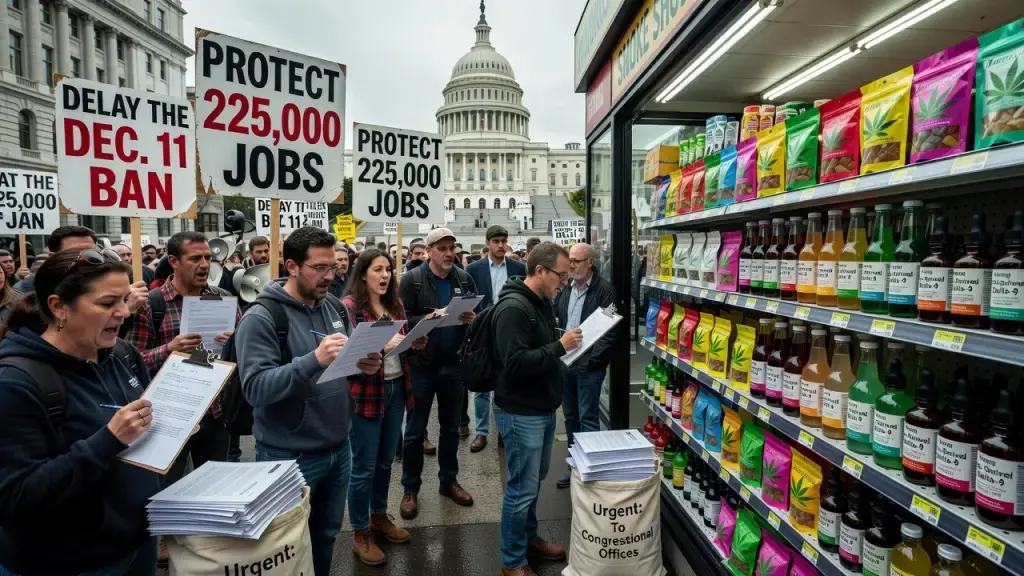
A pro-legalization advocacy group is lobbying Congress to block a federal rule set to take effect Dec. 11 that would outlaw most intoxicating hemp-derived products currently sold nationwide. The Marijuana Policy Project (MPP) is mobilizing supporters to flood congressional offices with letters opposing what it calls a prohibition-style crackdown, just as rival cannabis trade groups push lawmakers to let the ban proceed as scheduled.
What Changes on Dec. 11
The provision stems from language Congress attached to the legislation that ended a 43-day government shutdown last November. Under the new definition, hemp will mean a cannabis plant containing no more than 0.3% total THC - a standard that now includes THCA and other cannabinoids with comparable effects, not just delta-9 THC alone. That's a meaningful technical shift. Many hemp products currently on shelves were formulated under the old 2018 Farm Bill standard, which measured only delta-9 THC and left THCA largely unregulated at the federal level.
Products will also become federally illegal if they contain cannabinoids synthesized outside the plant, cannabinoids incapable of being naturally produced by Cannabis sativa L., or more than 0.4 milligrams of total THC per container. That last threshold is tight enough to sweep up a large share of existing beverage, gummy and tincture SKUs built around synthetic or concentrated hemp-derived THC. For retailers stocking these items - convenience stores, smoke shops, even some grocery chains - the practical effect is a forced reformulation or a pulled product line, with little runway to adjust wholesale menus or clear existing inventory.
Two Industries, One Loophole, Opposing Interests
Here's the catch: this isn't a unified industry fight. It's regulated cannabis versus unregulated hemp, and the economics explain why. Licensed, state-regulated operators absorb excise taxes, seed-to-sale tracking costs, strict packaging and lab-testing requirements, and the Section 280E federal tax burden tied to handling a Schedule I substance. Hemp-derived intoxicants sold under the old Farm Bill definition have largely avoided all of that - no age-gating mandate in many states, no COA requirements as rigorous as state cannabis programs demand, and none of the tax drag that cuts into a licensed dispensary's margin.
That imbalance is exactly why groups like the U.S. Cannabis Roundtable and the American Trade Association for Cannabis and Hemp back the Dec. 11 closure. Their argument, in plain terms: this isn't a ban, it's parity. Multi-state operators including Trulieve, Curaleaf and Ascend Wellness have lobbied House and Senate offices directly, framing the loophole closure as overdue leveling of a playing field that's let untested intoxicants move through gas stations and convenience stores without the compliance infrastructure licensed retailers are required to maintain.
What's at Stake for Operators on Both Sides
MPP's counterargument centers on scale and disruption. Its sample letter to lawmakers cites a hemp marketplace supporting roughly 225,000 jobs and generating an estimated $28 billion in retail sales, according to Whitney Economics - figures the group uses to argue that abrupt prohibition, rather than regulation, would push consumers toward an unregulated illicit market overnight. The group wants Congress to prioritize age restrictions, testing standards and labeling requirements over an outright cutoff.
For dispensary owners and compliance teams, the outcome matters regardless of which side wins. A hard closure could reduce shelf-level competition from unregulated intoxicating hemp, potentially strengthening wholesale pricing power for licensed brands. A further delay - or a permanent regulatory carve-out - would extend the competitive pressure regulated retailers have faced for years from products that sidestep excise taxes and 280E exposure entirely. Either way, operators should expect compliance logs, vendor contracts and product testing protocols to face renewed scrutiny as Congress decides whether regulation or prohibition defines the next chapter of the hemp and cannabis markets.