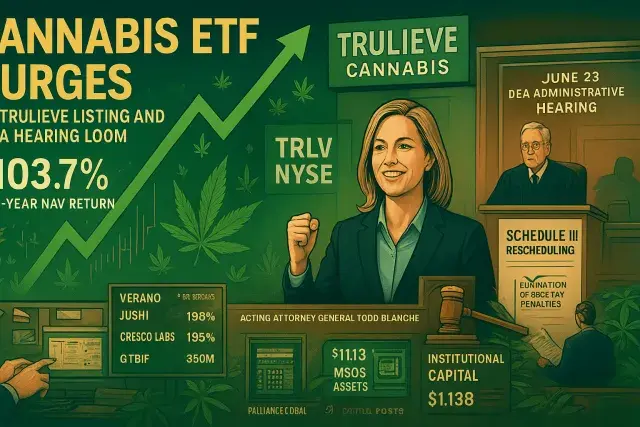
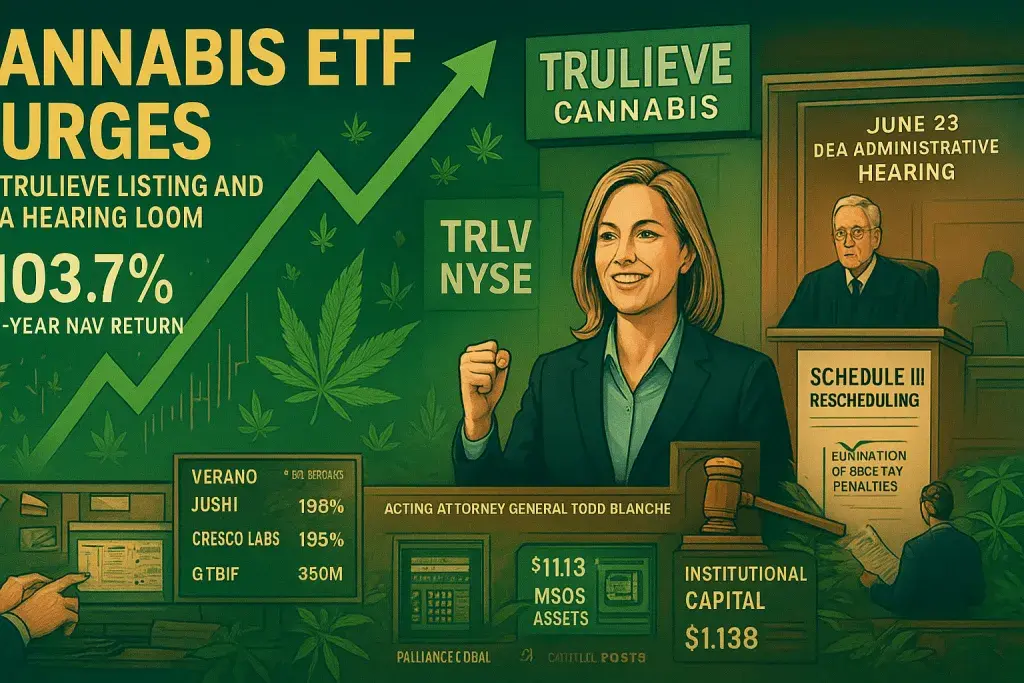
Cannabis stocks are having a moment few in the sector expected this early in the year. The AdvisorShares Pure US Cannabis ETF (MSOS) has climbed to its highest levels of 2026, with a one-year net asset value return of 103.7% through May 31 - nearly triple the North American Marijuana Index's 36.9% gain and well ahead of the S&P 500's 29.8%. Money is moving fast, and it's moving on two catalysts: Trulieve's new NYSE listing and a June 29 DEA hearing that could reshape how the federal government treats marijuana.
MSOS now oversees $1.13 billion in assets as of June 5, up sharply after a 28% three-month gain even as the broader marijuana benchmark slipped about 1%. That divergence matters. It tells you capital is concentrating in a handful of multi-state operators rather than spreading evenly across the sector - a pattern typical when investors are betting on specific regulatory outcomes rather than underlying retail performance. For operators watching capital markets from the outside, the same forces reshaping Wall Street sentiment are also reshaping back-of-house priorities: cleaner compliance logs, tighter inventory controls and modernized retail infrastructure, including systems like dispensary point of sale software rhode island, are increasingly what separates a scalable operator from one stuck fighting fires. dispensary point of sale software rhode island
Trulieve's Uplisting and What It Signals
Trulieve Cannabis, MSOS' largest holding at roughly 30% of assets, began trading on the NYSE under the ticker TRLV this week. CEO Kim Rivers called it a "historic milestone," and she credited the federal move to reclassify medical marijuana to Schedule III with helping clear the path. Here's the mechanism that made it possible: Trulieve separated its medical cannabis operations from its adult-use business, a structural change that let it meet listing standards on a senior U.S. exchange. That's not a cosmetic maneuver. It's a template other multi-state operators will likely study closely, since exchange access brings cheaper capital, broader institutional ownership and far more scrutiny than the over-the-counter market ever demanded.
Alliance Global, maintaining a "Buy" rating and a C$27 price target on Trulieve, points to the company's concentration in medical-only states and its exposure to expanding markets such as Texas and Georgia as a distinct advantage. Fair enough - medical-only footprints carry less regulatory whiplash than adult-use markets, where price compression and oversupply have hammered margins in states like California and Michigan.
Why the DEA Hearing Carries Real Weight
The administrative hearing set for June 29, expected to run through no later than July 15, will examine whether cannabis broadly - not just state-licensed medical products - should move to Schedule III. This follows Acting Attorney General Todd Blanche's April action placing state-licensed medical marijuana into Schedule III, which eliminated 280E tax penalties for licensed medical operators. In practice, that means those companies can finally deduct ordinary business expenses: payroll, rent, interest, the basic costs of running a retail operation that plenty of other small businesses take for granted. Trump's formal nomination of Blanche as permanent attorney general has only reinforced investor confidence that this policy direction holds.
Broader rescheduling, if it happens, would extend those tax benefits industry-wide and open doors to banking services and institutional capital that have been effectively closed since legalization began. Roth Capital called the rescheduling order "extremely favorable," citing improved capital access and a clearer runway toward uplistings. Cresco Labs' new $50 million revolving credit facility from Needham Bank is an early example - CEO Charlie Bachtell described it as a "non-dilutive tool" for acquisitions and a step toward a senior exchange listing.
Where the Upside - and the Risk - Actually Sits
Trulieve gets the headlines, but it's not where the biggest projected upside lives. Verano (VRNO) shows 195% upside to its price target, followed by Jushi Holdings (JUSHF) at 183% and Cresco Labs (CRLBF) near 99%, according to Koyfin data. Green Thumb Industries (GTBIF) stands out among the larger holdings at 70% upside, ahead of both Trulieve and Curaleaf (CURLF), the industry's largest company by revenue. Glass House (GLASF) is the outlier with projected downside of 22%, a reminder that rescheduling optimism doesn't lift every operator equally.
- Retail sentiment on Stocktwits shows MSOS, TCNNF and GTBIF rated "extremely bullish" on heavy message volume
- Tilray (TLRY), outside MSOS, has signaled it may use recent capital raises for acquisitions tied to reform expectations
- Price targets and analyst ratings reflect regulatory forecasts, not guaranteed outcomes
None of this changes the operational reality on the ground. Dispensaries still answer to state seed-to-sale tracking systems, METRC reporting, lab testing requirements and compliant packaging rules regardless of what happens in Washington. A federal rescheduling decision would ease tax and banking pressure, but it won't rewrite state licensing caps, local zoning fights or the day-to-day discipline required to keep a retail operation compliant. Investors chasing the sector's next winner should remember that stock performance and dispensary-level fundamentals are related, but they are not the same story.