A recent webinar on DEA enforcement and cannabis rescheduling drew far more questions than the hour allowed. The unanswered ones point to a pattern worth noting: operators, patients, and even attorneys are still working through what the Final Order actually changed, and what it didn't. Schedule III status, it turns out, is not the sweeping fix many assumed it would be.
Schedule III Status Hinges on Licensing Details
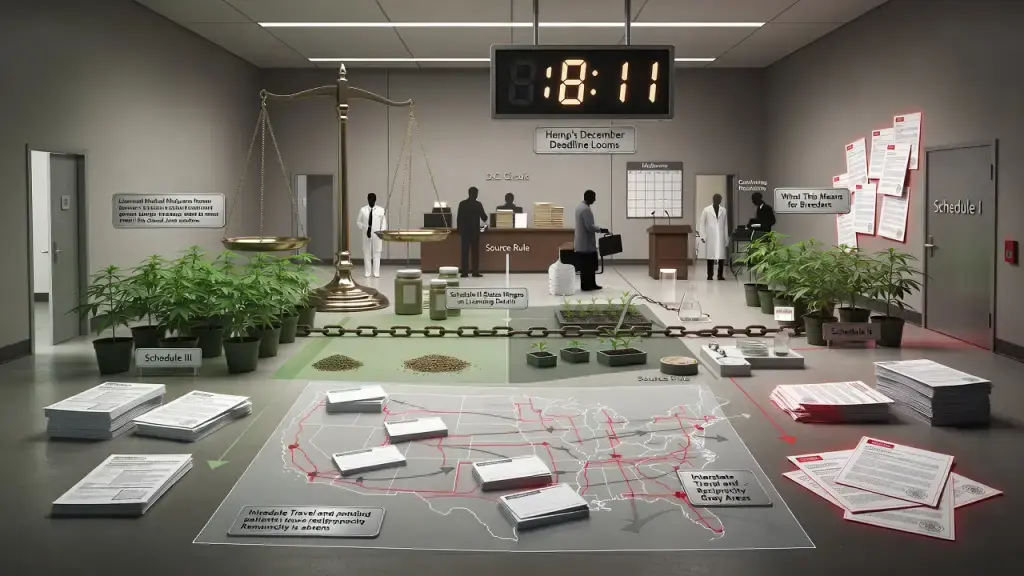
Here's the catch that trips up a lot of people: homegrown medical marijuana only qualifies for Schedule III treatment if it's grown under a specific state medical marijuana license, such as a caretaker designation. Adult-use home grow, or medical cultivation without that particular license, likely stays Schedule I. That's a narrow door, not a wide one.
And Schedule III classification alone doesn't equal federal legality. Under the Final Order's framework, a licensed home grower also needed to apply for DEA registration during the expedited window that closed in June. Miss that window, and the operation remains in violation of federal law regardless of its state license. Operators still waiting for clarity should treat Schedule III as a procedural category, not a green light.
Interstate Travel and Reciprocity Remain Gray Areas
Patients hoping the Final Order settled interstate travel questions should pump the brakes. The order addresses entities that dispense medical marijuana, not patients who possess it. State law still governs transportation and possession, and a valid out-of-state recommendation offers no protection in states with restrictive marijuana laws. Until federal agencies issue clearer guidance, patients should keep treating interstate travel the way they did before the order was issued.
Reciprocity between state medical programs faces similar uncertainty. Reports suggesting DEA will block reciprocity outright aren't backed by language in the Final Order itself. Absent a formal rule or memorandum of agreement, those reports shouldn't be read as binding federal policy. Medical marijuana also remains distinct from a prescription drug under the Food, Drug and Cosmetic Act; the industry's continued use of terms like "recommendation" and "certification" instead of "prescription" reflects that distinction, not sloppy terminology.
Hemp's December Deadline Looms Over the Midterms
The November midterms are unlikely to affect the rescheduling litigation now before the D.C. Circuit, since that process runs through the executive and judicial branches rather than Congress. Hemp policy is a different matter entirely, and the clock is louder there. Even a decisive Democratic sweep wouldn't produce hemp legislation before the new Congress convenes in January, which leaves the December 11 deadline as the immediate flashpoint for hemp operators, brands, and retailers stocking hemp-derived products.
A continuing resolution extension, rather than standalone legislation, looks like the more plausible outcome if any relief comes at all. Senate leadership dynamics add another layer of uncertainty: broader cannabis legislation has historically taken priority over narrower, more achievable hemp fixes, and there's little reason to expect different treatment this time. Without White House involvement, another extension becomes harder to secure, and that involvement is not guaranteed.
What This Means for Breeders, Nurseries, and DEA Timing
Cannabis seeds face a particularly rough landing if Congress doesn't act. Absent a legislative fix that specifically protects seeds, they're likely to be classified as marijuana once new hemp restrictions take effect in December, creating real complications for breeders and nurseries operating in that space. Clones and tissue cultures sit in murkier territory; they weren't explicitly swept into the hemp restrictions, which could actually improve their legal footing compared to before, though that's far from a settled question. A legal theory known as the Source Rule, which ties a cannabinoid's legal status to its source material, could resurface in enforcement or prosecution contexts.
On the regulatory side, DEA isn't legally required to wait for the D.C. Circuit's ruling before issuing registrations, though doing so would likely spare the agency the administrative burden of unwinding registrations later through Order to Show Cause proceedings. That operational reality may explain why the Attorney General chose to treat expedited applicants as compliant with federal law while their registrations remain pending, rather than rushing approvals that could later need to be revoked.
For dispensary operators, compliance teams, and multi-state operators tracking this, the throughline is consistency: rescheduling created a conditional pathway, not a blanket exemption, and every operational decision built on it should start with the state license and application timeline, not assumptions about what Schedule III implies.