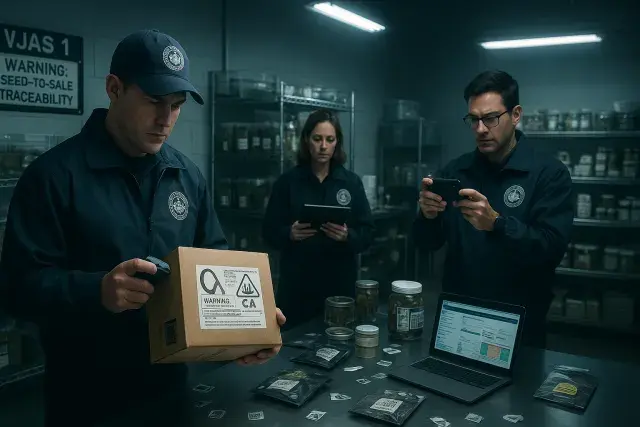
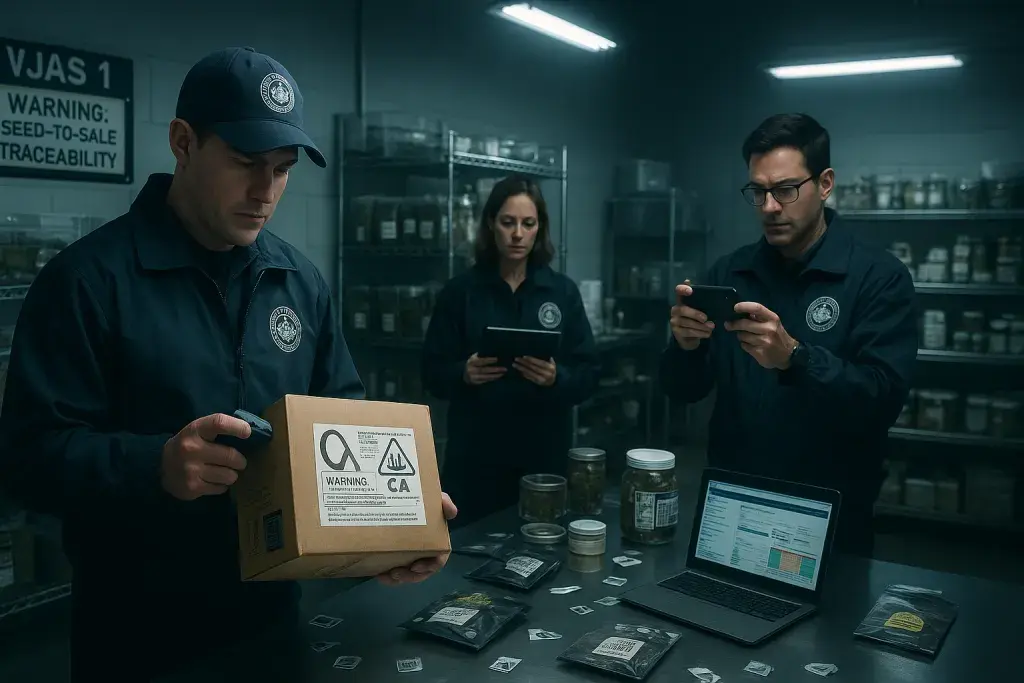
Michigan's Cannabis Regulatory Agency has filed a formal complaint against VJAS 1, a licensed cannabis processor in Harrison Township, after an inspection turned up more than 12,000 individual products lacking Metrc tags or any other identifying information. Among those untagged items: products packaged in California-specific labeling, carrying "CA" markings and consumer warnings written to meet California's regulatory requirements - not Michigan's. The company is now facing potential fines, license suspension, revocation, restriction, and refusal of renewal.
That's not a paperwork problem. That's a fundamental breakdown of seed-to-sale traceability - the entire compliance architecture Michigan and every other regulated cannabis state depends on to keep unlicensed product out of the legal supply chain. Metrc, the track-and-trace platform most U.S. cannabis markets use, assigns unique tags to every plant, batch, and packaged unit that moves through a licensed facility. When 12,000 units show up with no tags, there's no audit trail, no chain of custody, no way to verify origin, testing history, or lab results. For context, operators in other regulated markets - including those running a marijuana pos oregon compliant system - understand that Metrc integration isn't optional infrastructure; it's the baseline proof that your inventory is legitimate.
What makes this case harder to dismiss as administrative sloppiness: investigators found that some products at the facility did carry valid Metrc tags. After cross-referencing those tags against the state's tracking system, regulators discovered those tagged products were supposed to be physically located at other licensed cannabis businesses. That's a different category of problem entirely. It suggests product movement - or product misrepresentation - across multiple licensed entities, which is exactly the kind of diversion scenario state enforcement teams are built to catch.
Why Untagged Inventory Is a Red Flag, Not a Minor Violation
In a regulated cannabis market, an untagged product is effectively a ghost. It has no legal existence within the licensed supply chain. It can't be traced to a licensed cultivator or manufacturer. It can't be verified against a certificate of analysis. It can't be legally transferred, sold, or even stored without raising immediate compliance questions. Facilities carrying thousands of such units aren't just out of compliance with a recordkeeping rule - they've created conditions where regulators can't determine whether consumers were ever exposed to products that met Michigan's testing and labeling standards.
The California-packaged products add a layer of concern that goes beyond inventory management. California's cannabis labeling requirements - including specific warning language, required symbols, and packaging standards - are distinct from Michigan's. A product in California packaging isn't just mislabeled for the Michigan market; it raises the direct question of whether it was ever part of Michigan's licensed supply chain at all. Interstate cannabis commerce remains federally prohibited, and no state-level license grants a processor the right to introduce product that originated under another state's regulatory framework.
The Compliance Pressure This Case Puts on Every Michigan Operator
VJAS 1's situation is an extreme example, but it points to operational risks that licensed processors and retailers across Michigan - and every other regulated state - should take seriously. Here's the thing: Metrc compliance failures tend to compound. A missing tag on one batch can cascade into reconciliation errors across an entire inventory log. When employees at a licensed facility can't explain why thousands of untagged products are present, that's not just a gap in knowledge - it's a signal that internal inventory controls either don't exist or aren't being enforced.
For operators running compliant facilities, the practical takeaways are direct:
- Metrc tag reconciliation should be a routine internal audit function, not something that only happens when a state inspector arrives.
- Any product entering a facility - from any source - must be verified against the state's tracking system before it's accepted into inventory.
- Employees who handle product intake need clear, documented protocols for flagging untagged or improperly labeled items.
- Packaging that carries another state's compliance markings has no place in a Michigan licensed facility.
Enforcement actions like this one don't exist in a vacuum. The CRA's willingness to pursue formal complaints, potential license revocation, and financial penalties against a licensed processor sends a message to the broader market about how seriously Michigan is treating supply chain integrity. Operators who treat Metrc compliance as a bureaucratic formality are the ones most exposed when inspectors show up unannounced.
What's at Stake for the Licensed Market
Licensed cannabis markets are, at their core, built on a single premise: that regulated product is traceable, tested, and verifiably different from what moves through unlicensed channels. When a licensed processor holds thousands of untagged products - some of which carry packaging from a different state - that premise takes real damage. It's not just a legal problem for the operator involved. It's the kind of case that fuels public skepticism about whether state-licensed markets are actually delivering on consumer safety promises.
VJAS 1's outcome will depend on how Michigan's administrative process unfolds, but the charges filed reflect the full weight of what the CRA can bring: fines, license suspension, revocation, restriction, and refusal to renew. Any one of those outcomes ends or severely curtails the ability to operate. For a licensed cannabis business, there's no recovering from a revocation quickly - the licensing process alone makes that clear.
Compliant operators are watching. They should be.