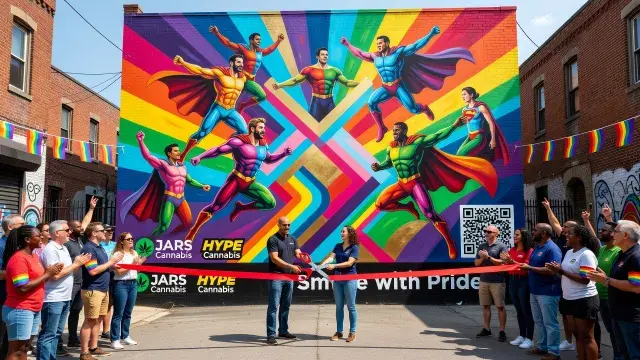
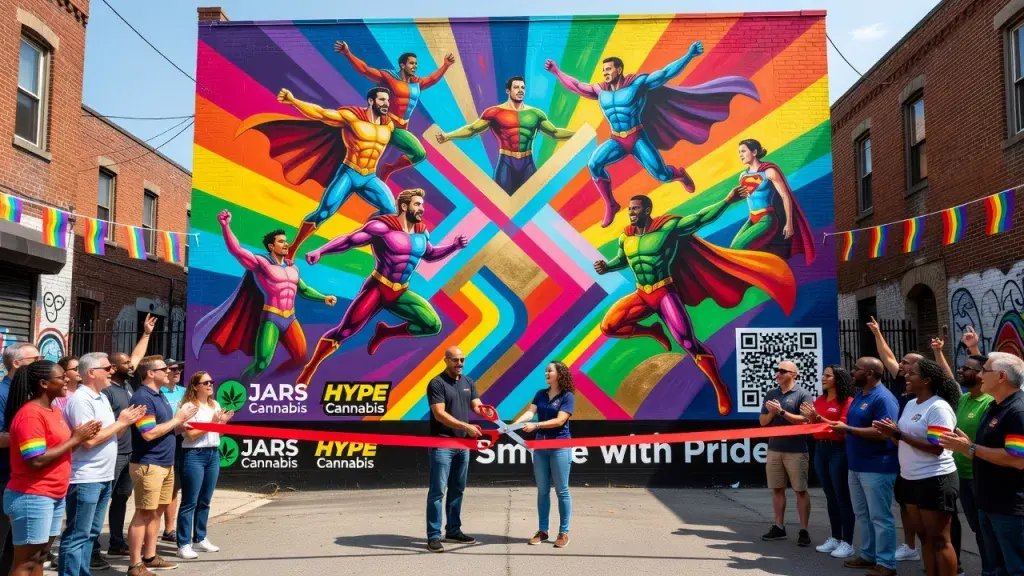
Two Michigan cannabis retailers cut the ribbon this week on a mural project that doubles as a fundraising mechanism, a reminder that dispensary marketing budgets increasingly function as community infrastructure spend. JARS Cannabis and HYPE Cannabis commissioned "Polychromatic Super You," a 40-by-25-foot piece by Michigan artist Joey Salamon, installed in an alley off W. Nine Mile Road in downtown Ferndale. The mural anchors the companies' Smoke with Pride campaign, which directs a share of certain product proceeds to Detroit's Ruth Ellis Center, a support and safe-space organization for at-risk LGBTQ+ youth.
The mechanics matter here as much as the imagery. Ten percent of proceeds from HYPE products sold at JARS locations, and the full proceeds from a co-branded Smoke with Pride kit, get routed to the nonprofit - a structure that requires clean SKU management and accurate point-of-sale reporting to track which transactions qualify. That's not a small operational lift. Retailers running cause-marketing promotions like this one need software capable of isolating specific product lines at checkout, generating auditable donation totals, and keeping that data separate from standard sales and excise tax reporting. Operators in adult-use and medical markets outside Michigan face the same technical requirements when structuring giveback campaigns, and platforms like Minnesota seed-to-sale dispensary software illustrate how compliance-grade tracking tools are built to handle exactly this kind of segmented reporting without compromising METRC integrity. Minnesota seed-to-sale dispensary software
A QR code affixed to the mural links visitors to campaign information and a direct donation portal for the Ruth Ellis Center - a low-friction way to convert foot traffic into nonprofit support without routing everything through in-store transactions. That's a smart hedge, frankly, since not every passerby is a cannabis consumer, and age-restricted products can't be the only entry point for a public-facing campaign tied to a mural in an open alley.
Why Retailers Turn to Cause Marketing
Cannabis brands operate under tighter advertising constraints than most consumer categories - no broadcast placements in many markets, restrictions on imagery that could appeal to minors, and limits on where signage and promotional material can appear. Public art sidesteps a lot of that. A mural isn't a cannabis advertisement in the regulatory sense; it's a civic contribution that happens to carry a brand's name and a cause. For operators boxed in by state marketing rules, that distinction matters. It creates visibility without triggering the same compliance review that a billboard or dispensary-branded flyer might.
There's also a reputational calculation. JARS Marketing Director Stefanie Michels framed the project around the historical overlap between cannabis reform and LGBTQ+ advocacy, both movements built on pushing back against criminalization and stigma. Whether or not every customer draws that line, the campaign gives the brand a way to signal values without making health claims or promotional statements about the product itself - a distinction regulators watch closely in cannabis advertising.
What Operators Should Take From This
Multi-store operators and single-location dispensaries alike can learn something from the structure here, not just the sentiment. Cause-linked promotions require documentation: donation totals need to reconcile against sales records, and any public claim about "100 percent of proceeds" or "10 percent of proceeds" has to hold up if a regulator, journalist, or nonprofit partner asks for the math. Loose bookkeeping on a feel-good campaign can turn into a credibility problem fast.
- Segment promotional SKUs clearly in POS systems to isolate donation-eligible sales
- Keep donation reporting separate from standard tax and excise filings
- Verify that public art or sponsorship placements comply with local sign and zoning ordinances
- Confirm advertising content avoids health claims or consumption encouragement, even in cause-marketing contexts
None of this diminishes the gesture. It just means the back-office work behind a mural unveiling is less glamorous than the ribbon-cutting - and considerably more important to getting the campaign right.