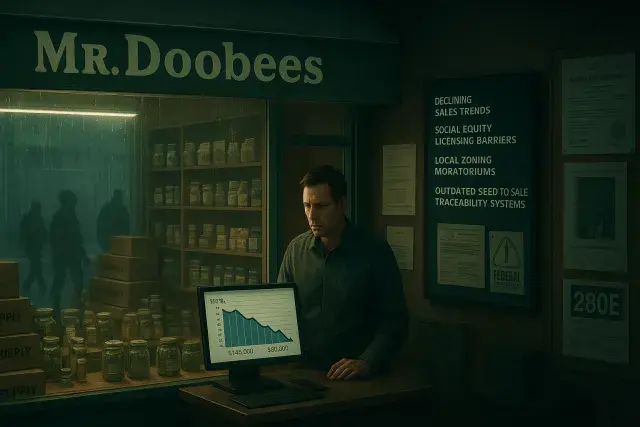
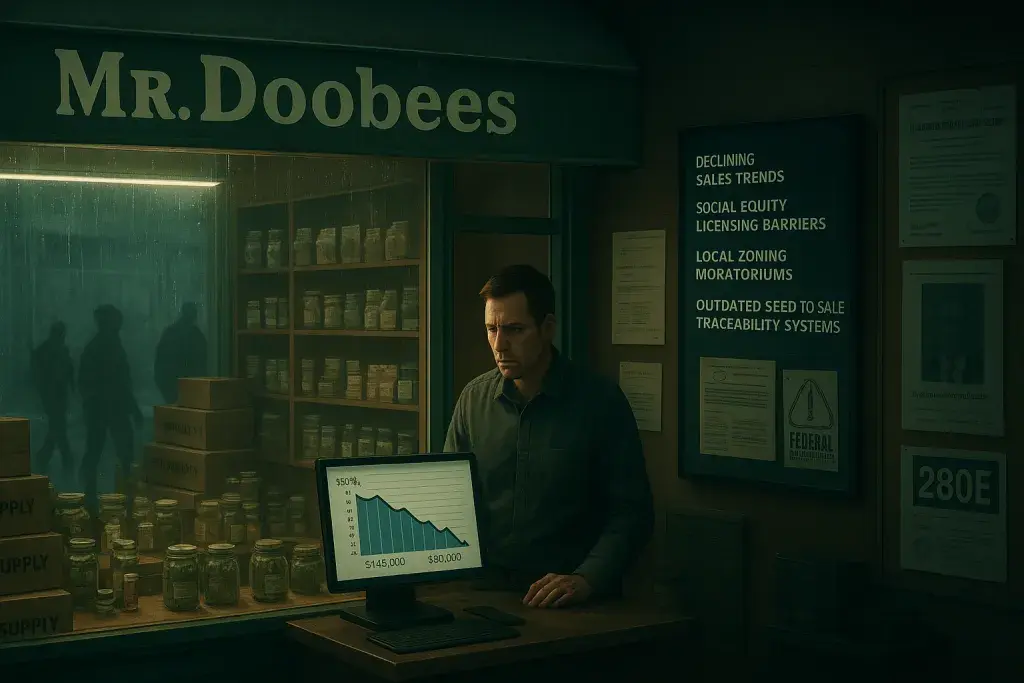
H.J. Norris, owner of Mr. Doobees in Seaview, Washington, sold roughly $80,000 in cannabis product in January - down from approximately $145,000 during the same month a year earlier. That 30% decline, which Norris attributes in part to post-COVID demand softening, is not an isolated data point. It reflects a legal market under pressure from multiple directions at once: federal policy uncertainty, persistent oversupply, illicit-market competition, and a structural imbalance between the number of licensed producers and the retail outlets that actually move product to consumers.
The operational reality for stores like Mr. Doobees is that thinning margins leave little room for error. Wholesale pricing pressure - driven by too many producers chasing too few retail doors - compresses the spread between cost of goods and the shelf price consumers will actually pay. Operators who invested in compliant point-of-sale systems, seed-to-sale traceability infrastructure, and staff training during the growth years of the market now carry those fixed costs against a shrinking revenue base. Retailers in comparable adult-use markets have faced similar dynamics; tools like marijuana pos software nevada vendors offer illustrate how operators across state lines are leaning harder on technology to tighten inventory management and reduce shrinkage when sales volume alone won't sustain the business.
Washington State Liquor and Cannabis Board Executive Director Will Lukela and Director of Policy and External Relations Justin Nordhorn laid out the broader regulatory picture during a recent appearance on TVW's "Inside Olympia." Their assessment was candid. The illicit market, Lukela said, is "thriving" - even as board data suggests most consumers are purchasing through licensed channels. That gap between perception and measurable enforcement outcomes is a familiar frustration in regulated cannabis states. Unlicensed operators don't carry the excise tax burden, compliance packaging costs, or lab-testing requirements that licensed retailers do, which means they can undercut legal shelf prices by a significant margin. For a store already down 30%, that's not an abstraction. It's the difference between covering payroll and not.
Federal Rescheduling Adds Uncertainty Without Adding Clarity
The federal rescheduling question hangs over Washington's market in a specific way. Because the state runs integrated medical and adult-use systems - rather than maintaining separate regulatory tracks - any federal action that touches medical cannabis could ripple through the entire licensed market. Lukela acknowledged the board is still working through what recent federal developments mean in practice. "We're still searching for what it means," he said. That's an honest answer. It's also, from an operator standpoint, an unsatisfying one. Dispensaries can't restructure banking relationships, renegotiate lease terms, or adjust compliance posture against a policy change that hasn't been defined yet.
The 280E tax burden - which prevents cannabis businesses from deducting ordinary business expenses under federal tax law because cannabis remains a Schedule I controlled substance - is one of the most concrete financial pressures on licensed retailers. If rescheduling proceeds and 280E no longer applies to cannabis operations, the cash-flow implications for compliant dispensaries would be material. But that outcome is not guaranteed, and the timeline remains unclear. Operators are wise to plan conservatively.
Small-Business Ownership Model Faces Structural Strain
Washington deliberately built its cannabis market around a small-business model. The state's five-store ownership cap was designed to prevent the kind of consolidation that has reshaped adult-use markets in other states. A new law reinforced that cap by closing a management agreement loophole - arrangements through which larger operators could, in practice, exert influence over additional retail locations without holding a license for them. The board identified those agreements as a threat to the ownership model the state set out to build.
Here's the catch, though. Structural protections for small operators only hold if those operators can stay solvent. A market with more producers and processors than retail doors - the structural imbalance Nordhorn described - means wholesale menus are crowded and buyers have pricing power. That's good for per-unit cost at the counter, in theory. In practice, it deepens the margin squeeze for producers and increases the volume pressure on retailers who need to move more SKUs to hit revenue targets. Small independent stores feel that first.
Social Equity Licensing and Local Zoning Remain Unresolved
Social equity licensing - intended to create pathways for applicants whose communities were disproportionately affected by prior cannabis prohibition - continues to move slowly. Dozens of licenses remain available under the program, but financing and local zoning restrictions are doing real work as barriers. Lukela estimated roughly 70 jurisdictions in Washington maintain some form of cannabis ban or moratorium. That's a meaningful constraint on where new licensed retail can actually open, which in turn limits the reach of the legal market and, by extension, the state's ability to compete with unlicensed operators in those areas.
Access to capital is a related problem that doesn't resolve itself at the state level. Traditional lenders remain cautious about cannabis-industry exposure. Without financing, a social equity applicant holding a license can't build out a compliant retail space, invest in point-of-sale and inventory systems, or carry the working capital a new store needs to reach profitability. The license itself is only the first hurdle.
Traceability Modernization Is the Board's Near-Term Priority
On a forward-looking note, the board identified updating Washington's cannabis traceability system as a near-term priority. Seed-to-sale tracking - the mechanism through which regulators follow cannabis product from cultivation through retail sale - is foundational to market integrity. An outdated or unreliable traceability infrastructure creates gaps that complicate enforcement, undermine accountability, and erode public confidence in the licensed market's legitimacy. Modernization won't fix wholesale pricing dynamics or shut down illicit operators overnight. But it matters. A cleaner data environment gives regulators better tools to identify diversion, support audit functions, and make the case that licensed-market oversight is working - which is an argument the industry needs regulators to be able to make credibly.
For operators like Norris, the near term is simpler and harder than any policy debate: the store sold $80,000 last month when it used to sell $145,000. Every variable above - federal uncertainty, illicit competition, oversupply, local zoning - lands on the income statement of a single retail location. That's the market Washington's regulators are describing. And it's the market its licensed dispensary owners have to run a business in.