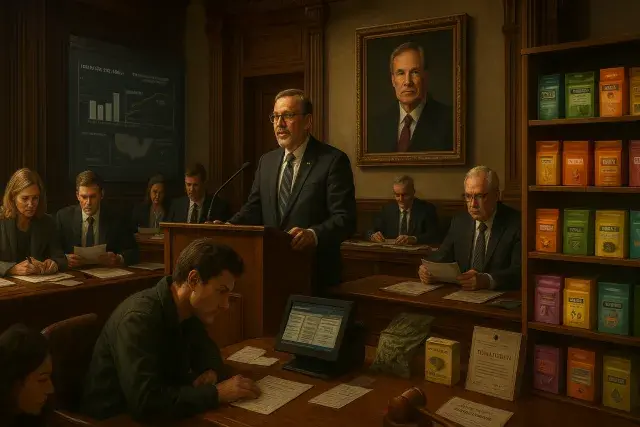
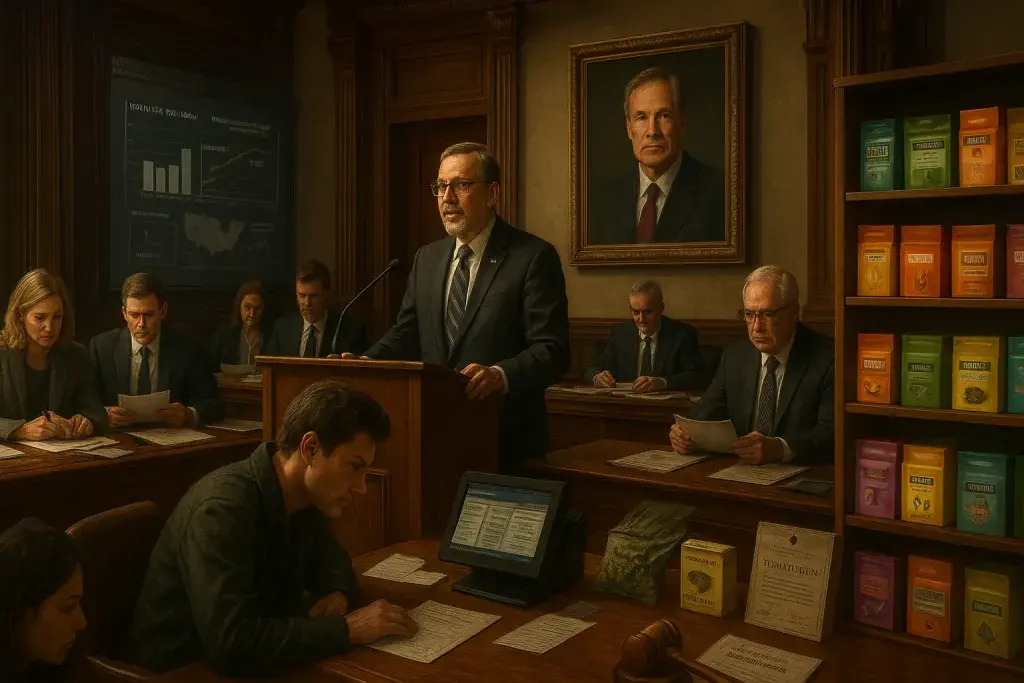
Texas lawmakers held a public hearing on July 7 to examine the health effects of hemp-derived THC products - delta-8, delta-10, and THCA flower among them - signaling that a renewed push for prohibition is likely when the next legislative session convenes. No legislation was filed. The session was explicitly a fact-finding exercise. But Sen. Charles Perry has already said he intends to file a ban again, which means operators selling intoxicating hemp products in Texas are watching a familiar clock start over.
For retailers currently moving hemp-derived THC products in Texas, the uncertainty is not abstract. These businesses have spent real money on compliant packaging, updated labeling, lab-verified certificates of analysis, and licensing fee increases that took effect under the March 31 regulatory overhaul from the Texas Department of State Health Services. Many have also invested in a point-of-sale built for cannabis retail that tracks inventory, records age verifications, and generates the compliance logs that regulators increasingly demand - only to find that the legal ground beneath those investments keeps shifting. Industry groups challenged the March rules in court; a judge temporarily blocked enforcement while litigation continues. So the regulatory floor is itself unsettled, even before the next session adds another layer of political risk.
Here's what operators need to understand about where Texas actually stands.
What the Regulatory Overhaul Already Changed - and Why It's Contested
The March 31 rules were a direct consequence of Gov. Greg Abbott's veto of the legislature's outright ban last year. Abbott directed state agencies to increase oversight rather than prohibit the market entirely. What followed was a set of rules that tightened the definition of compliance around total THC - not just delta-9 THC at harvest - which effectively rendered certain popular products noncompliant regardless of how they tested at the point of extraction.
THCA flower is the clearest example. In raw form, THCA is non-intoxicating. It does not exceed any threshold that would make it illegal under a straightforward reading of the federal Farm Bill framework. But when heated - smoked, vaped, combusted - it converts into delta-9 THC. Texas regulators argued, reasonably from a consumer-safety standpoint, that a product that functions as marijuana once consumed shouldn't be treated differently from marijuana at the point of sale. Industry argued, also reasonably from a legal standpoint, that the rules applied a standard that wasn't grounded in statute. A court agreed enough to pause enforcement.
That temporary injunction is not a business plan. Operators who treated it as one are exposed.
What the Senate Hearing Signals About the Next Legislative Push
The July 7 hearing before the Senate Committee on Health and Human Services covered ground that will be familiar to anyone who followed last session's debate: youth access, calls to poison control centers, cannabis use disorder, and data from the Texas Department of Family and Protective Services showing an increase in infants who tested positive for THC at birth between fiscal years 2024 and 2025. Lawmakers heard from health experts. They gathered testimony. They are building a record.
That process matters for the industry because legislative record-building is how durable bans get written. Last session's prohibition failed not because opposition won the argument but because Abbott chose a regulatory path over an outright ban. If next session produces a bill that is narrower, more carefully constructed, and tied directly to the health testimony gathered this summer, the political calculus could be different. There is no guarantee Abbott would veto again.
Retailers and hemp brands operating in Texas should treat the next session as genuinely high-risk - not a repeat of the last standoff.
The Business Exposure Is Broader Than Just Texas
Texas isn't operating in isolation. Several states have moved to restrict or ban hemp-derived intoxicating products over the past two years, and the federal regulatory picture for hemp-derived cannabinoids remains unresolved. The 2018 Farm Bill created the opening; subsequent federal inaction left states to manage the consequences on their own schedules, with their own standards, producing the fragmented compliance environment that now makes multi-market hemp retail genuinely complicated.
For brands wholesaling into Texas dispensaries and hemp retailers, the practical question is inventory exposure. If a ban passes and takes effect quickly, products sitting in warehouses or on retail shelves become a liability - not just unsellable, but potentially subject to destruction or seizure depending on how the legislation is written. That's a supply-chain and financial risk that wholesale pricing doesn't typically price in.
For licensed operators, the more immediate obligation is operational. Child-resistant packaging, accurate total-THC labeling, product testing documentation, and detailed recordkeeping aren't just regulatory checkboxes - they're the paper trail that demonstrates good faith in the event of an inspection or a licensing review. Operators who are not maintaining those records now, while the injunction holds, are making a bet that enforcement will never come. That's a bad bet in a state where the political momentum is clearly moving toward more restriction, not less.
The Texas hemp THC debate is, in the end, a compliance story wrapped inside a policy story. The policy outcome is uncertain. The compliance obligation is not.