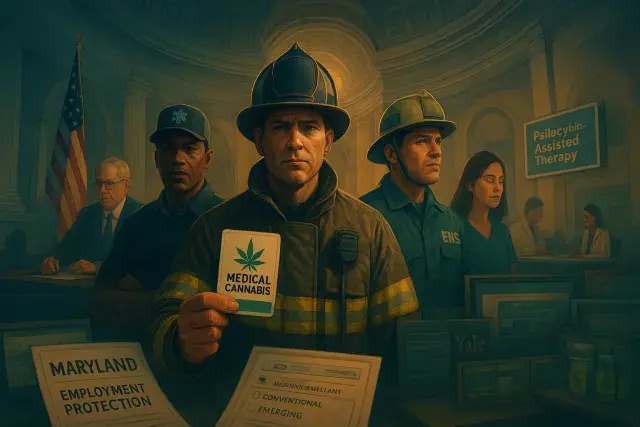
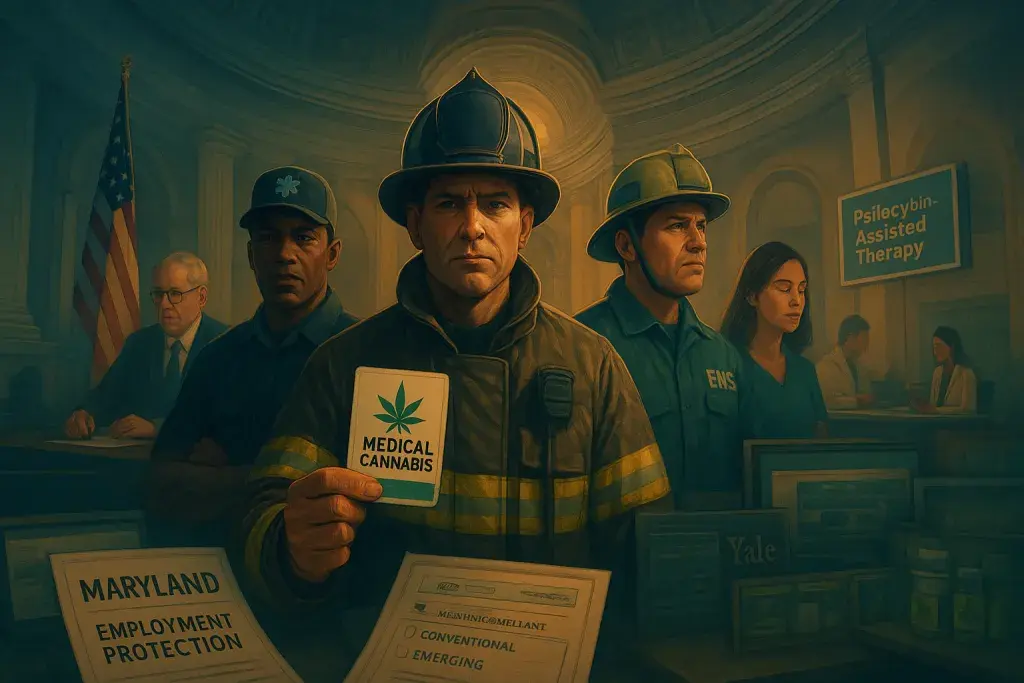
A growing number of states are expanding how they address post-traumatic stress among first responders - moving past the traditional prescription-and-counseling model toward a broader set of legal, clinical, and workplace protections. The shift is happening through a mix of legislative vehicles: new commissions, employment protections, and expanded research access. For the cannabis industry, the legal employment protections now being codified in states like Maryland carry direct operational implications for medical cannabis programs, dispensary operators, and the employers who serve registered patients.
Maryland's new law, effective October, prohibits employment discrimination against firefighters, EMTs, paramedics, and other rescue workers who are registered medical cannabis patients and test positive for cannabis metabolites - provided they are not impaired while on duty. That distinction matters. It separates metabolite presence from functional impairment, a line that dispensaries, cannabis software vendors, and workforce compliance professionals have been tracking closely. Operators building out tools to help employers and licensed cannabis retailers manage patient access and recordkeeping - including companies that have built their platform around supporting regulated dispensary markets - will recognize this as part of a broader pattern: state law is increasingly distinguishing between presence and impairment, and that distinction reshapes who can legally be a medical cannabis patient without risking their livelihood.
The Maryland approach is significant because it signals a maturing attitude toward medical cannabis patients in high-stakes professions. Historically, first responders have faced a hard binary - hold a medical cannabis card or hold your job. That chilling effect suppressed patient registration in exactly the population PTSD programs are meant to serve. Removing that barrier has real downstream effects on patient volume, dispensary traffic, and the kinds of products medical programs need to stock. It also puts pressure on compliance officers at multi-location operators to track jurisdictional rules with precision; a policy valid in Maryland may expose an employer to liability just across the state line.
Ohio and the Commission Model: Structured But Slow
Ohio Gov. Mike DeWine's approach is different in character - administrative rather than protective. The new Post-Traumatic Stress Injury Commission will review applications from eligible first responders and help cover treatment costs. The commission model creates a formal channel for care access, but it also introduces a bureaucratic layer: application review, eligibility determination, cost reimbursement. That's not inherently a problem, but in practice, first responders who need help often need it quickly. A commission that takes months to render decisions may not serve the most acute cases well. Worth watching: what treatments the commission ultimately certifies as reimbursable, and whether that list eventually opens to include therapies beyond conventional psychiatry.
Psilocybin and Ibogaine Enter the Legislative Record
Two states - Connecticut and Missouri - advanced measures touching on psychedelic-assisted therapy, though with different outcomes. Connecticut expanded a Yale University pilot program studying psilocybin-assisted therapy, opening participation to any state resident 18 or older who meets the clinical criteria set by Yale's institutional review board. Previously, the program was limited to veterans, retired first responders, and frontline health care workers. Missouri lawmakers moved a bill that would have allowed veterans and first responders in approved research studies to receive psilocybin and ibogaine under medical supervision for PTSD and related conditions - but the legislature adjourned in May before the bill reached the governor's desk.
These are not cannabis regulations. But they belong to the same regulatory and cultural conversation. States willing to authorize psychedelic-assisted therapy research - even narrowly, even in a university setting - are demonstrating an appetite for non-traditional interventions in mental health policy. That appetite has already benefited cannabis. The framing of medical cannabis as a PTSD treatment option gained traction in state legislatures years before it became a standard qualifying condition in most medical programs. The current push around psilocybin and ibogaine is following a recognizable arc.
What This Means for the Licensed Cannabis Industry
The business takeaway here is not abstract. Employment protections for registered medical cannabis patients in high-risk professions expand the pool of people who can legally participate in state medical programs without professional consequence. That matters for patient counts, for qualifying condition utilization, and for the downstream economics of medical dispensaries that have watched adult-use conversions erode their patient base in states that have gone dual-license.
Jason Cerrano, a retired firefighter and paramedic with more than 20 years of experience in Missouri, put it plainly: in first responder culture, trauma accumulates incrementally - "the crazy stuff starts to at least seem normal." That normalization of trauma is precisely what makes intervention difficult, and late. The state-level moves happening now reflect a recognition that the existing toolkit isn't adequate. For cannabis operators and compliance professionals, the practical question is whether their medical programs, patient intake procedures, and product menus are positioned to serve a patient population that, in some states, just got a new layer of legal protection to actually show up.