
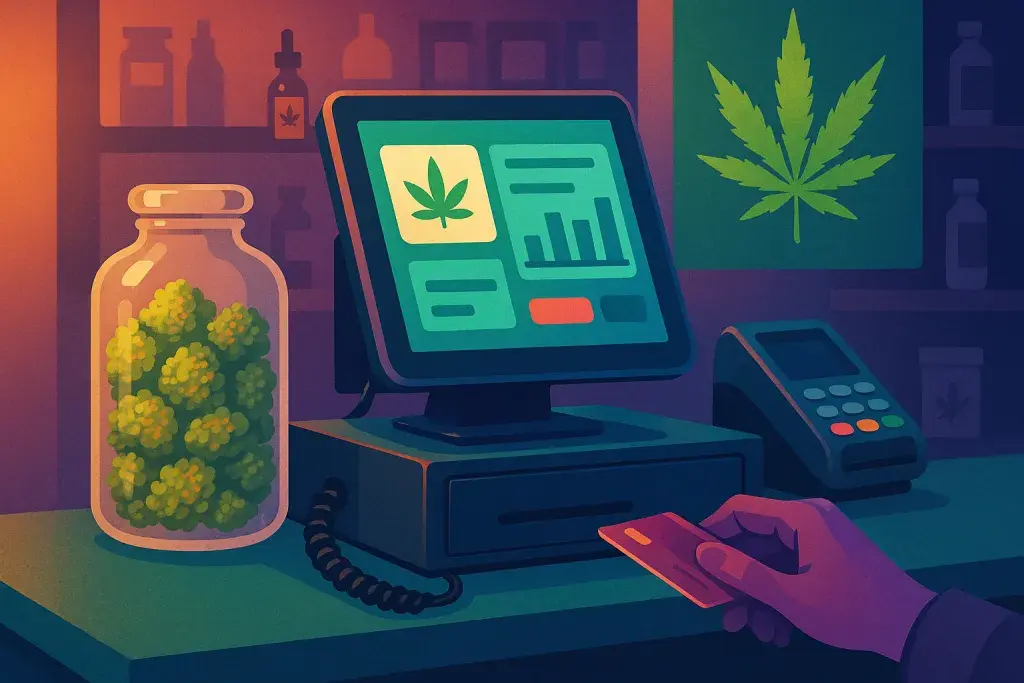
Running a cannabis retail business means operating under a microscope. Regulators track every gram sold, every patient served, every transaction recorded. Unlike most retail sectors, a dispensary that loses control of its inventory or fails a compliance audit doesn't just face fines - it risks losing its license entirely. The technology powering your sales counter isn't a back-office detail. It's the operational spine of your entire business.
Most dispensary owners discover this the hard way: they open with a basic retail setup, hit their first state inspection, and find their system can't produce the reports regulators require. The right cannabis dispensary POS isn't just a cash register with cannabis-friendly features - it's an integrated platform that connects your sales floor to your compliance obligations, your supplier relationships, and your customer data simultaneously. As you evaluate your options, understanding what a purpose-built cannabis retail pos actually does versus what a generic system attempts to replicate is the single most important distinction to grasp before making any purchasing decision.
This guide walks through every dimension of that decision: compliance architecture, inventory controls, hardware requirements, staff workflows, customer-facing features, and total cost of ownership. Whether you're opening your first weed shop or replacing a system that's outlived its usefulness, what follows gives you a framework to evaluate your options with clarity.
Understanding What a Cannabis Dispensary POS Actually Does
Beyond Basic Transactions: The Regulatory Layer
A standard retail point-of-sale system records sales, processes payments, and generates receipts. A cannabis dispensary POS does all of that - and then keeps doing work after the transaction closes. Every sale must be reported to your state's seed-to-sale tracking system, whether that's Metrc, BioTrackTHC, or another platform your jurisdiction mandates. The POS has to push that data automatically, accurately, and in the correct format, every time.
This distinction matters more than any feature comparison chart. When a dispensary point of sale fails to sync properly with the state tracking system, the resulting discrepancies don't resolve themselves. They accumulate, creating a gap between what the state believes you have in inventory and what you actually have. Reconciling those gaps during an audit is time-consuming, expensive, and sometimes impossible if records weren't maintained correctly from the start.
Cannabis-specific POS systems are built with compliance as a core function, not an add-on. The integration with state tracking is native, not patched together through a third-party workaround. That architecture difference affects reliability, update speed when regulations change, and the support you receive when something breaks.
The Difference Between Cannabis-Specific and Generic POS Adapted for Cannabis
Several general-purpose POS providers have added cannabis modules to their existing platforms. The appeal is familiarity - retailers who've used Square or Lightspeed in other businesses may feel comfortable with the interface. The problem is structural. These systems were designed for industries where a product is a product, not a controlled substance with per-transaction limits, medical versus recreational distinctions, and mandatory state reporting.
A cannabis-specific marijuana retail software platform, by contrast, was built from the ground up assuming that every sale involves a regulated product. Daily purchase limits are enforced at the cart level. Patient medical records integrate directly with the transaction flow. Compliance reports are generated automatically, not assembled manually after the fact.
The practical difference shows up under pressure - during a rush, during an audit, or during a software update that changes how your state tracking system accepts data. Generic systems adapted for cannabis tend to require more manual intervention at exactly these moments. Purpose-built systems handle them within their normal workflow.
Core Functions Every Weed Shop POS Must Cover
Before evaluating specific platforms, establish a baseline of non-negotiable functionality. Any weed shop POS you seriously consider should handle all of the following without requiring third-party workarounds:
- Real-time integration with your state's seed-to-sale tracking system
- Automatic enforcement of purchase limits by customer type (medical vs. recreational)
- Age and ID verification at the point of sale
- Compliant receipt generation that meets state labeling requirements
- Cash management tools, including reconciliation and till counts
- Support for cashless payment options where legally permitted
- Role-based access controls for staff permissions
- Offline functionality to maintain sales capability during internet outages
Systems that can't demonstrate all of these functions natively should be disqualified early in your evaluation, regardless of price or interface appeal.
Cannabis Inventory Management: The Foundation of Compliance
Why Inventory Accuracy Is a Legal Obligation, Not Just Good Practice
In most retail industries, inventory shrinkage is a business problem. In cannabis retail, it's potentially a criminal matter. Regulatory agencies require dispensaries to account for every unit of product from the point it enters the facility to the point it's sold or disposed of. Unexplained discrepancies trigger investigations. Repeated discrepancies trigger license reviews.
Cannabis inventory management therefore operates under a different standard than general retail inventory control. It's not enough to know approximately how much product you have. You need to know exactly, and that count needs to match what the state tracking system shows at any given moment.
A well-designed dispensary POS treats inventory as a living record. Every receiving event, every transfer, every sale, every waste disposal updates inventory in real time and pushes a corresponding update to the state system. When a budtender scans a product at the point of sale, the inventory count adjusts immediately - not at the end of the day, not during a batch sync, but within seconds of the transaction completing.
Receiving, Transfers, and Waste Management Workflows
Cannabis inventory management begins before a product ever reaches the sales floor. When a delivery arrives from a licensed distributor or cultivator, your system needs to verify that what's physically delivered matches what the state tracking system shows as transferred. Receiving workflows that prompt staff to scan each package, confirm quantities, and flag discrepancies immediately prevent problems from entering your inventory at the source.
Internal transfers - moving product from a vault to the sales floor, or between departments in a vertically integrated operation - also require documentation. Sloppy transfer records are one of the most common sources of inventory discrepancies found during audits. A dispensary point of sale that treats internal transfers as a formal, documented workflow rather than an informal handoff creates a paper trail that protects the business.
Waste management is another area where documentation requirements are strict. Expired products, damaged packaging, and unsaleable inventory must be destroyed according to state protocols and recorded in a way that satisfies regulators. Your system should generate the required waste manifests and ensure the corresponding inventory adjustments flow to the state tracking system automatically.
Real-Time Stock Visibility and Reorder Management
Operational efficiency is the other side of inventory management. Knowing what you have is the compliance dimension. Knowing what you're about to run out of is the business dimension. Good cannabis inventory management software provides both simultaneously.
Real-time stock visibility means managers can see current inventory levels for every SKU across every department without running a manual count. Automated reorder alerts notify purchasing staff when a product drops below a defined threshold. Sales velocity data shows which products move quickly and which sit on shelves, informing both purchasing decisions and promotional strategy.
For dispensaries with multiple locations, centralized inventory visibility becomes even more critical. A multi-store operation running on a properly integrated platform can see stock levels across all locations from a single dashboard, identify which store has excess inventory of a slow-moving product, and initiate a compliant inter-location transfer to balance stock - all without printing a single form manually.
Evaluating Marijuana Retail Software: Key Features That Matter
Reporting and Analytics Capabilities
The quality of a dispensary's reporting infrastructure determines how well management can actually run the business. Basic sales reports - daily totals, top products, revenue by category - are table stakes. The marijuana retail software platforms worth serious consideration go further: cohort analysis showing how customer purchasing behavior changes over time, margin reporting by vendor and product line, staff performance metrics, and compliance report generation that formats data exactly as your state agency requires it.
Compliance reporting deserves particular attention during any evaluation. Ask vendors to demonstrate how their system generates the specific reports your state requires. Then ask how quickly those report formats are updated when regulations change. The answer to the second question often reveals more about a vendor's operational reliability than any feature demonstration.
Customer Relationship and Loyalty Features
Repeat customers are the economic engine of a healthy dispensary. A customer who visits twice a month is worth dramatically more than a one-time visitor, and the operational cost of serving them is lower because they already know the product, the process, and the staff. Marijuana retail software that includes a robust loyalty program helps build that repeat relationship systematically.
Effective loyalty features in a cannabis context require some specific accommodations. Discount programs must comply with state advertising and pricing regulations, which vary significantly. Customer purchase history must be stored securely and used only in compliant ways. Medical patient records require additional privacy protections under HIPAA or state equivalents.
The best platforms integrate loyalty mechanics directly into the transaction flow. When a budtender pulls up a customer's profile, they see loyalty point balance, purchase history, and product preferences in a single view - without navigating to a separate system or asking the customer to present a separate loyalty card.
Menu Management and Online Ordering Integration
Many dispensaries operate through third-party menu platforms that display current inventory to customers before they arrive. The connection between your dispensary point of sale and these menu services needs to be direct and real-time. When a product sells out at the counter, the online menu should reflect that within seconds, not hours.
Delayed menu updates create customer service problems - shoppers who arrive expecting a specific product that's already gone. They also create operational problems when online orders are accepted for products that no longer exist in sufficient quantity. Evaluate how each platform you consider handles menu synchronization, and test the sync speed during a demonstration, not just during a sales presentation.
Payment Processing in a Cannabis Environment
Cannabis businesses face payment processing constraints that most retailers never encounter. Many major card networks still decline to process cannabis transactions, leaving dispensaries reliant on cash, cashless ATM systems, ACH transfers, or cannabis-specific payment providers. Your weed shop POS needs to accommodate the payment methods available in your market without creating friction at the point of sale.
Cash management tools within the POS become correspondingly important. Systems that track cash from the moment it enters the till, support multiple till configurations, flag discrepancies during reconciliation, and generate end-of-day cash reports reduce the operational burden of running a high-volume cash business - and create the documentation trail that both internal management and external auditors may require.
Hardware Requirements and Setup Considerations
Tablets, Terminals, and Dedicated Hardware
Cannabis POS platforms run on a range of hardware configurations. Some are designed for iPad-based setups, offering flexibility and relatively low hardware cost. Others require proprietary terminals with integrated ID scanners, cash drawers, and receipt printers. Still others are cloud-based applications that can run on any modern browser-equipped device.
The right hardware configuration depends on your store layout, transaction volume, and budget. A small boutique dispensary doing light transaction volume can often operate effectively on a tablet-based setup. A high-volume shop with multiple concurrent registers needs a more robust hardware architecture with faster processors, dedicated receipt printers, and integrated ID verification hardware that doesn't add seconds to each transaction.
ID verification hardware deserves specific attention. Every sale requires age verification, and manual ID checks slow throughput and introduce human error. Integrated ID scanners that read driver's licenses and state IDs, verify age automatically, and flag expired or fraudulent documents reduce both compliance risk and transaction time.
Network Infrastructure and Offline Reliability
A dispensary POS that loses functionality every time the internet goes down is an operational liability. Cannabis retail depends on continuous transaction capability - a system outage during a busy Saturday afternoon costs real revenue and frustrates both staff and customers. Evaluate how each platform handles offline operation before committing to a purchase.
The standard for offline capability should be full transaction processing: the system should be able to complete sales, enforce purchase limits from a locally cached customer database, and queue state tracking updates for automatic transmission when connectivity restores. Systems that simply display an error message when connectivity drops are insufficient for cannabis retail environments.
Network infrastructure planning - dedicated internet connections, failover cellular connections, local network segmentation - sits outside the POS software itself but should be part of your overall technology planning when setting up a new location or upgrading an existing one.
Compliance Architecture: What to Verify Before Signing a Contract
State Tracking System Integration Depth
The phrase "integrated with Metrc" appears in the marketing materials of almost every cannabis POS vendor. What it actually means varies considerably. Some integrations push sales data to Metrc automatically after every transaction. Others require a manual export and import process. Some update inventory in real time. Others batch-sync once or twice daily.
The depth of that integration has direct consequences for compliance. When an audit occurs and regulators pull Metrc data to compare against your physical inventory, any lag in your sync creates apparent discrepancies. Apparent discrepancies require explanation. Explanations require documentation. Prevention is considerably easier than remediation.
During vendor evaluations, ask specifically: How frequently does your system push updates to our state tracking system? What happens to those updates during a connectivity outage - are they queued and sent when connectivity restores, or lost? How quickly do you update your integration when the state tracking system changes its API? Request references from dispensaries in your specific state who can speak to their experience with the integration in practice.
Audit Trail and Record-Keeping Standards
Cannabis regulations typically require businesses to maintain transaction records for a minimum number of years - the specific requirement varies by jurisdiction but is commonly three to seven years. Your marijuana retail software needs to maintain immutable records that can be retrieved quickly during an audit.
Immutable means that past records cannot be altered, even by administrators. A system that allows editing of completed transactions creates a compliance vulnerability, because regulators have no way to verify that the records they're reviewing represent what actually occurred. Look for systems that log all activity in a tamper-evident audit trail, where any corrections are recorded as new entries rather than replacements of old ones.
Regulatory Update Response Time
Cannabis regulations are not static. States add product categories, change packaging requirements, modify purchase limits, and update their tracking system specifications regularly. The software vendor you choose needs to respond to those changes quickly and push updates to your system before the effective date of any regulatory change.
Ask vendors directly: what is your typical response time when a state releases a regulatory change that affects your software? How are those updates delivered - do they require manual intervention on your part, or do they push automatically? Who is responsible for communicating upcoming regulatory changes to your customer base?
A vendor with dedicated compliance staff who monitor regulatory developments across all operating states is meaningfully different from a vendor where compliance updates are handled reactively by the same development team managing new feature releases.
Evaluating Vendors: Questions That Cut Through the Sales Presentation
Support Structure and Response Commitments
A POS system failure during business hours is an emergency. Unlike most software categories where downtime is an inconvenience, a cannabis dispensary that can't process transactions has to stop selling - a significant revenue impact compounded by potential compliance implications if the failure affects state tracking synchronization.
Evaluate vendor support structures with that reality in mind. What are the guaranteed response times for critical issues? Is support available during your operating hours, including evenings and weekends? Is there a dedicated support line for urgent issues, or does everything go through a ticketing system? What is the escalation path when a standard support interaction doesn't resolve the problem?
Request references from current customers who have experienced a system failure and can describe the vendor's actual response - not the promised response. The difference between what a vendor commits to in a contract and what they actually deliver under pressure is the most important information you can gather before signing.
Pricing Models and Total Cost of Ownership
Cannabis POS pricing varies widely. Some vendors charge a flat monthly fee per location. Others price per register, per transaction volume, or as a percentage of revenue. Hardware may be included, leased separately, or purchased outright. Implementation fees, training costs, and ongoing support fees may or may not be bundled into the base price.
Calculate total cost of ownership across a realistic operating horizon - three years is a reasonable minimum. Include software subscription fees, hardware costs and expected replacement cycles, implementation and training, ongoing support, and any per-transaction fees. A platform with a low monthly subscription but high per-transaction fees may be considerably more expensive at volume than a platform with a higher flat fee.
Understand contract terms carefully. Some vendors require multi-year contracts with significant early termination penalties. Others offer month-to-month arrangements. Multi-year contracts may offer pricing stability, but they also lock you in if the vendor's service quality declines or a competitor releases a significantly better product.
Implementation Timeline and Training Requirements
A new dispensary point of sale implementation involves more than installing software. Staff need training on transaction workflows, inventory receiving procedures, compliance-related processes, and troubleshooting basics. Data from any existing system needs to be migrated. Hardware needs to be configured and tested. State tracking integration needs to be verified.
Establish realistic expectations about implementation timelines before signing. A thorough implementation for a single-location dispensary typically requires several weeks of preparation before go-live, followed by a period of intensive support as staff work through their first real transactions on the new system. Vendors who promise a one-day implementation for a complex operation are either underestimating the work involved or planning to leave you to figure out the details yourself.
Making the Final Decision: A Framework for Comparison
Building an Evaluation Scorecard
With multiple vendors in consideration, structured comparison is more reliable than gut feel. Build a scorecard that weights criteria according to their importance to your specific operation. Compliance integration depth should carry significant weight for any licensed dispensary. Support quality matters more for a high-volume operation with extended hours. Inventory management sophistication matters more for a multi-location or vertically integrated business.
Weight each criterion, score each vendor against it, and calculate a weighted total. Then compare the totals against pricing to assess value. The highest-scoring system at a given price point is not automatically the right choice - a system that scores slightly lower but comes with demonstrably better support may be the more defensible business decision.
The Pilot Period and Reference Check Process
Before finalizing any decision, conduct reference checks with dispensaries of similar size, volume, and regulatory environment. Ask specific questions: How has the system performed during peak hours? How responsive has the vendor been during compliance updates? Have there been any significant outages, and how were they handled? Would you choose this vendor again?
If a vendor offers a pilot period or trial, structure it to test the scenarios that matter most to your operation: a high-volume transaction period, a receiving workflow, a compliance report generation, and a simulated state tracking sync. Edge cases reveal system quality more accurately than smooth demonstrations of standard functionality.
Long-Term Partnership Considerations
The cannabis industry is still evolving. Regulations will change. New states will come online. Federal policy may shift. The vendor you choose today needs to be a viable business partner three, five, and ten years from now - financially stable, responsive to industry changes, and capable of expanding their platform as your business grows.
Evaluate vendor stability as part of your decision. How long have they been operating in the cannabis space? What is their customer retention rate? Are they investing in product development, or does their platform appear to have stagnated? Do they have a meaningful presence in the states where you operate or plan to expand?
A cannabis dispensary POS is not a commodity purchase. The right system becomes infrastructure - embedded in your daily operations, your compliance processes, and your customer relationships. Choosing it deserves the same rigor you'd apply to any major capital investment.
Frequently Asked Questions
Can I use a general retail POS like Square or Shopify for my dispensary?
General retail platforms are not designed for cannabis compliance and typically violate their own terms of service if used to process cannabis transactions. They lack native integration with state seed-to-sale tracking systems, cannot enforce purchase limits, and don't generate the compliance documentation regulators require. Using them exposes your license to significant risk.
How does a cannabis POS handle the difference between medical and recreational customers?
A purpose-built cannabis dispensary POS maintains separate customer profiles for medical patients and recreational buyers, enforcing the different purchase limits that apply to each category. Medical patient verification - including checking that a medical card is current and valid - happens within the transaction flow before the sale is completed, with the verification logged in the customer record.
What happens to my inventory data if my internet connection goes down?
Quality cannabis POS systems maintain a local cache of inventory data and continue processing transactions during outages. The system queues any required updates to the state tracking platform and transmits them automatically when connectivity restores. You should confirm this capability specifically with any vendor you evaluate, because offline functionality varies significantly across platforms.
How difficult is it to switch cannabis POS systems if I'm already operational?
Switching systems while operational requires careful planning. Historical transaction data may or may not be portable depending on your current platform's export capabilities and your new platform's import capabilities. The state tracking integration needs to be reconfigured and tested before go-live. Staff training should occur before switching, not after. Most dispensaries find it least disruptive to switch at a natural business pause - after a holiday rush, at the start of a new quarter, or during a planned renovation closure.
What should I look for in cannabis inventory management specifically for a multi-location operation?
Multi-location operations need centralized inventory visibility across all sites from a single dashboard, the ability to initiate and document compliant inter-location transfers, consolidated reporting that can aggregate or segment by location, and role-based access that allows location managers to see their own inventory without accessing other locations' data. The state tracking integration needs to correctly attribute all inventory movements to the right license, which becomes more complex when multiple licenses are involved.
Are there POS systems that support both adult-use and medical sales within the same store?
Yes, and this is a required capability for dual-license dispensaries. The system needs to maintain strict separation between transaction types for compliance purposes while presenting a streamlined workflow to budtenders. The interface should make it clear which type of transaction is being processed, enforce the correct purchase limits for each, and generate compliant receipts that accurately reflect whether the sale was medical or recreational.