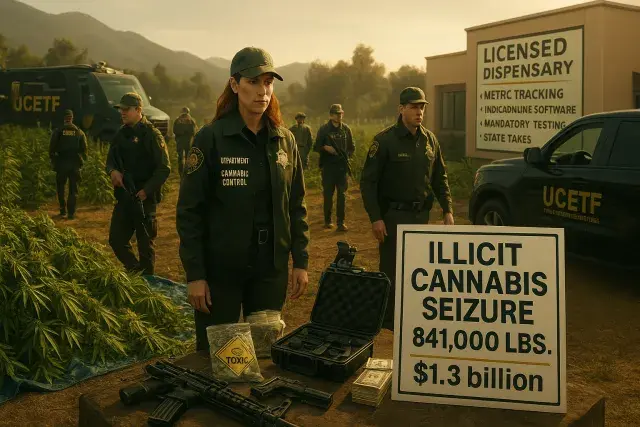
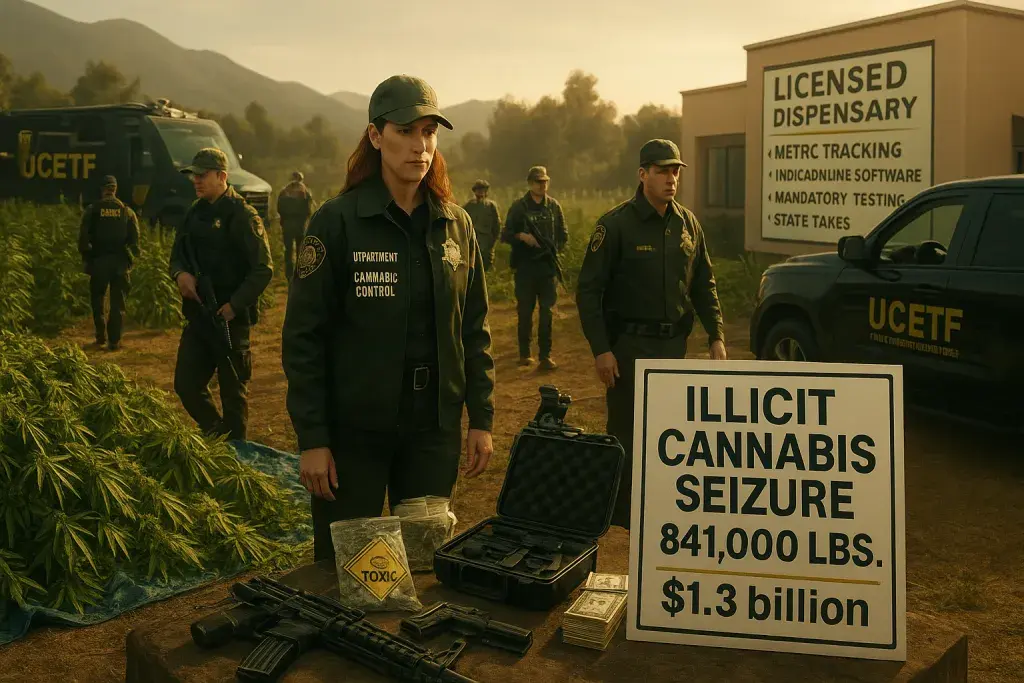
Since Governor Gavin Newsom established the Unified Cannabis Enforcement Task Force in 2022, California has seized and destroyed more than 841,000 pounds of illicit cannabis - roughly 420 tons - valued at over $1.3 billion. The latest quarterly results, covering April through June 2026, show the task force isn't slowing down: state and local partners seized more than 63,000 pounds of illegal product, eradicated nearly 90,000 plants, made 24 arrests, and confiscated 17 firearms across 10 counties in three months. For licensed operators, that enforcement pressure is both welcome and instructive.
The scale of these numbers matters to any licensed cannabis retailer trying to run a compliant operation in a competitive market. Illicit product undercuts regulated dispensaries on price precisely because it skips the costs that licensed operators absorb - state excise tax, mandatory lab testing, compliant packaging, seed-to-sale tracking through systems like METRC, and the full overhead of regulatory compliance. Operators building out retail technology stacks - point-of-sale systems, inventory management, compliance reporting tools like IndicaOnline dispensary software in Rhode Island and comparable platforms in California - are investing in infrastructure that illicit sellers simply ignore. Every pound of untested, unlicensed cannabis moving through the black market represents lost sales for compliant dispensaries and a direct consumer safety risk.
What's striking about the Q2 2026 UCETF operations isn't just the volume - it's the character of what investigators found. The Ventura County operation alone yielded nearly 6,000 cannabis plants, 17 firearms including an assault weapon, illegal drugs, and more than $205,000 in cash, resulting in 14 arrests. In Los Angeles County, officers discovered methamidophos at two cultivation sites - a highly toxic organophosphate pesticide that is banned for use on cannabis and poses serious risk to consumers if it enters the supply chain as undetected residue on processed product. Tulare, Kern, and Los Angeles county sites showed similar patterns: banned, unregistered, or foreign-labeled pesticides found at 13 cultivation sites associated with the largest single enforcement action of the quarter.
Pesticide Contamination Is the Hidden Consumer Safety Problem
The pesticide findings deserve more attention than they typically get in enforcement announcements. Regulated dispensaries are required to sell only cannabis that has passed state-mandated laboratory testing - testing that checks for residual solvents, heavy metals, microbial contamination, and pesticide residues, among other parameters. A certificate of analysis, or COA, accompanies every compliant product batch through the licensed supply chain. Illicit product has none of that. CDFW Director Meghan Hertel put it directly in the state's announcement: consumers who purchase illegally grown, processed, and sold cannabis have no way of knowing whether it was tested for safety. Toxic pesticides don't disappear during processing. That's a product safety gap the regulated market has structurally closed - and one the illicit market exploits by simply not paying for testing.
What Licensed Operators Should Take From These Results
For dispensary owners and multi-location operators, sustained UCETF enforcement serves a practical market function. The task force has now executed more than 750 search warrants across 29 counties since 2022. That kind of consistent pressure raises the operational risk for illicit cultivators and distributors - seizure of $1.3 billion in product, 250-plus firearms confiscated, $2.8 million in cash taken, and 100 arrests don't leave criminal networks unaffected. In theory, that should tighten illicit supply and narrow the price gap between black market and licensed retail. In practice, though, the illicit market in California remains large enough that enforcement alone hasn't closed it. Licensed operators still compete against untested product sold below their cost of compliance.
The real operational takeaway is this: the regulatory infrastructure that burdens licensed retailers - METRC integration, mandatory testing, excise tax collection, compliant packaging, employment law compliance - is also the infrastructure that makes their product verifiably safe. That's a retail differentiation argument that dispensary operators haven't always been able to make loudly, partly because marketing cannabis remains heavily restricted under state and local rules. But the enforcement record gives the licensed industry a factual foundation: regulated cannabis comes with a documented chain of custody, laboratory verification, and state oversight. Illicit cannabis, as these enforcement actions confirm repeatedly, comes with firearms, banned pesticides, and no consumer protections at all.
The Multiagency Model and What It Signals for Compliance Professionals
UCETF's co-chair structure - the Department of Cannabis Control and the California Department of Fish and Wildlife, coordinated through the Governor's Office of Emergency Services - reflects something important about how California views the illicit market problem. It's not purely a cannabis regulatory issue. It's an environmental crime issue, a public safety issue, a labor exploitation issue, and an organized crime issue simultaneously. The quarterly operations involve the State Water Quality Control Board, the California National Guard, county sheriff's offices, local police departments, district attorneys, and tax enforcement agencies. That breadth means illicit operators face exposure across multiple enforcement vectors at once, not just from cannabis regulators.
For compliance professionals at licensed cannabis businesses, the practical implication is straightforward: the state is running a coordinated, multi-year enforcement program with documented results, and it is not pulling back. DCC Director Clint Kellum said the task force's purpose includes keeping "enforcement pressure on illegal operations that pose risks to consumers and undermine the progress of the regulated industry." Licensed operators who maintain clean compliance records, accurate METRC logs, and properly documented wholesale sourcing are insulated from this enforcement environment. Those who don't are not - and the same agencies dismantling illicit grow sites can also audit licensed operations that show irregularities. The distinction between licensed and unlicensed isn't just legal status. At this point in California's regulated market, it's a business risk profile.