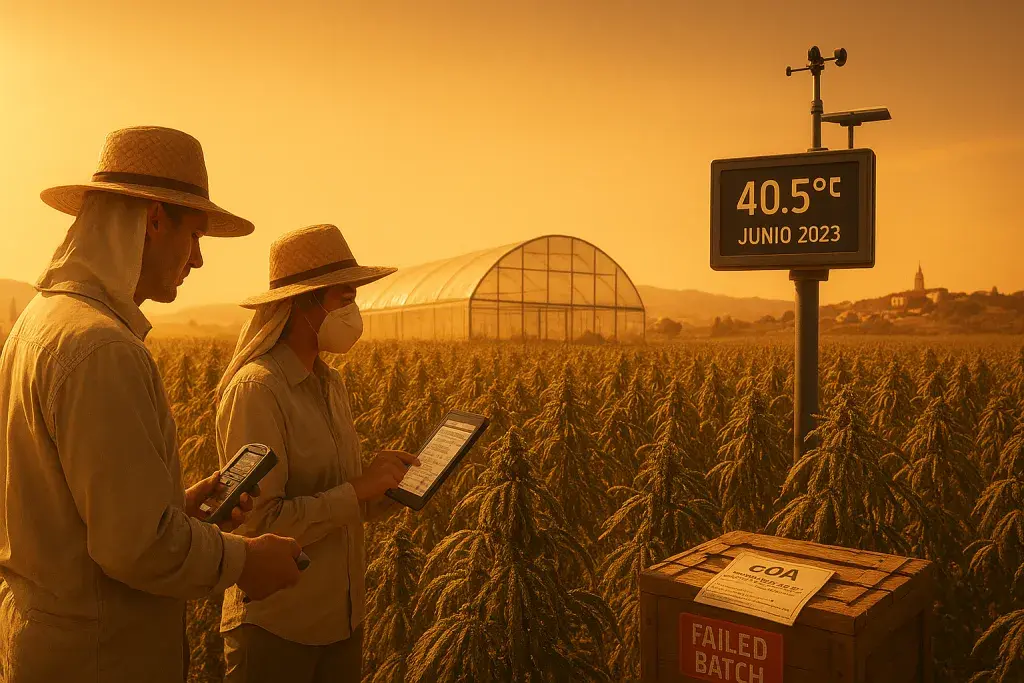
Spain is recording its hottest June temperatures since systematic weather tracking began in 1950 - and the health and agricultural toll is already measurable. The country's national meteorological agency, Aemet, confirmed that the current heat event will rank among the most intense early-summer episodes in modern Spanish history, with temperatures expected to remain elevated through at least mid-week. For licensed cannabis cultivators operating in southern Europe's regulated outdoor and greenhouse markets, this is not an abstract weather story.
The operational parallel to cold-climate markets is worth drawing here. Operators running temperature-sensitive cannabis grow environments - whether in Spain's emerging licensed sector or in markets as geographically distinct as the American Pacific Northwest or Alaska - understand that environmental control is as much a compliance issue as it is an agronomic one. Batch integrity, harvest timing, and ultimately the COA results that underpin product-safety claims all trace back to what happens in the grow. A cannabis dispensary pos system alaska has to account for inventory sourced under cold-chain and short-season conditions; the inverse pressure - extreme heat stress on outdoor crops - creates equivalent volatility at the supply chain level. Product batches that fail potency or contamination thresholds because of heat-induced degradation during cultivation or post-harvest handling don't just represent lost revenue. They represent a compliance failure that cascades through seed-to-sale tracking logs, wholesale menus, and retail shelves. cannabis dispensary pos system alaska
Spain's first heat wave of 2025 began Sunday, affecting roughly 46 percent of the national population across more than 5,200 municipalities, according to the country's health monitoring system. The late-May precursor event had already registered more than 100 excess deaths by official count - a reminder that extreme heat carries consequences well beyond the agricultural sector. For any licensed outdoor cannabis operation in the region, that public health framing matters: regulators in markets where cannabis cultivation is permitted will increasingly scrutinize whether operators have heat-contingency protocols in place, both for worker safety and for product integrity.
A Pattern That Operators Can No Longer Treat as Anomaly
The frequency data makes the trend hard to dismiss. Between 1975 and 2000, Spain recorded two June heat waves. Between 2000 and 2025, that number reached ten. Five times the incidence in the same span of years - that is not statistical noise. It is a structural shift in operating conditions. And Spain's mean temperature has risen 1.75 degrees Celsius since 1961, a figure attributed to fossil fuel combustion and consistent with the broader European warming trajectory.
For cannabis supply chains, the business implication is direct. Outdoor and light-dep cultivation schedules built around historical climate averages are, simply put, unreliable planning tools now. Heat-stressed cannabis plants produce inconsistent cannabinoid profiles; post-harvest material stored inadequately during transport degrades faster; and pesticide or microbial contamination risks rise in high-temperature, low-humidity conditions. Any of these outcomes can trigger a failed lab test - which in a licensed market means the product cannot move through wholesale channels or onto dispensary shelves. The COA doesn't lie, and no amount of brand marketing recovers a failed batch.
What Regulated Operators Should Be Assessing Now
The operational response isn't complicated in principle, though it's expensive in practice. Climate-adaptive cultivation - expanded use of climate-controlled greenhouse infrastructure, heat-tolerant genetics, and harvest-timing flexibility - is the medium-term answer. In the near term, operators in affected regions should be reviewing their post-harvest cold-chain protocols, their transport documentation, and whether their inventory management systems can flag batch-level temperature exposure events.
On the compliance side, this is also a worker-safety story. Regulators in licensed cannabis markets - whether in EU jurisdictions moving toward a regulated framework or in established U.S. state markets - are watching how operators handle extreme-weather labor conditions. Heat-illness prevention plans, hydration access, modified outdoor work schedules: these aren't optional risk mitigations. In a licensed business, documented failures in worker safety carry regulatory consequences that can affect a license's standing.
The thing is, most licensed cannabis operators built their businesses around a climate that no longer quite exists. Adjusting to that reality is now a cost of doing business - not a forward-looking bet, but a present-tense operational necessity.