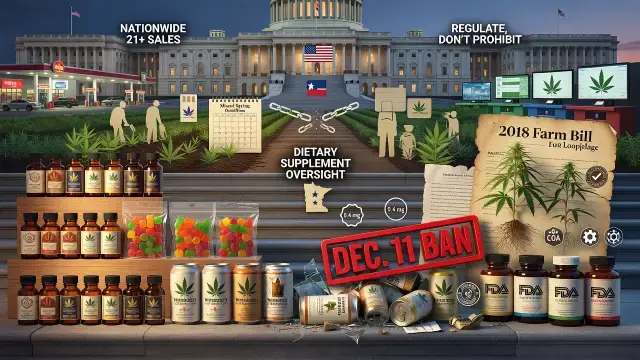
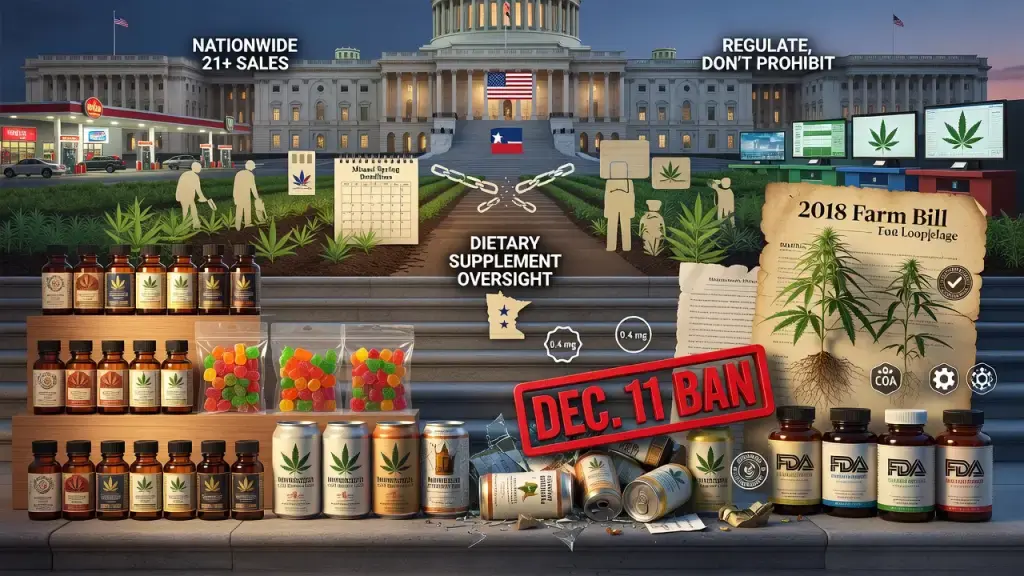
A bipartisan Senate bill introduced Tuesday aims to head off a federal rule set to take effect Dec. 11 that would cap hemp-derived THC at 0.4 milligrams per container - a threshold so low it would functionally eliminate most hemp beverages, edibles and tinctures currently sold nationwide. Sens. Amy Klobuchar, D-Minn., and Tim Sheehy, R-Mont., are proposing the Hemp Guardrails Act as an alternative to outright prohibition, betting that federal oversight can do what a blanket ban cannot: keep a legal, taxed supply chain intact while addressing the consumer-safety gaps that have dogged the hemp-THC market since 2018.
How a Farm Bill Loophole Built an Unregulated Market
The root problem goes back to the 2018 Farm Bill, which legalized hemp but failed to anticipate that chemists and brand owners would extract and convert hemp-derived cannabinoids into intoxicating THC products. That gap let drinks, gummies and other goods marketed as hemp - not cannabis - land on shelves in gas stations, convenience stores and breweries, entirely outside state cannabis licensing, seed-to-sale tracking and age-verification systems built for dispensaries. Congress closed that loophole last year with legislation Trump signed into law, setting up the Dec. 11 restriction. The trouble is, the fix traded one problem for another: instead of a regulated gray market, operators now face a near-total federal shutdown with no replacement framework for testing, labeling or age limits.
That's the tension the Hemp Guardrails Act tries to resolve. Rather than relying on a potency cap to do the work of regulation, the bill would hand the FDA authority over hemp-derived cannabinoid products as a category of dietary supplements - meaning COA requirements, manufacturing standards and labeling rules could finally apply consistently, something state-level programs have had to improvise around for years.
What Changes for Operators, and What Doesn't
For multi-state operators and hemp-beverage brands, the bill's most immediate business provision is a nationwide 21-and-over sales restriction - a standard Minnesota already enforces, but many states do not. Establishing that floor nationally would bring hemp-THC retail closer to alcohol-style compliance, with real implications for point-of-sale age verification, wholesale distribution agreements and liability exposure for retailers who currently sell with little federal guardrail at all.
In Minnesota, where state law already permits higher THC quantities per container than the federal rule would allow, the practical effect of passage would be continuity - businesses keep operating under a system they've already built compliance infrastructure around. Bob Galligan of the Minnesota Craft Brewers Guild, who worked with the sponsors on the bill, points to that state framework as evidence that regulation, not prohibition, is the workable path. Dozens of breweries in his guild's membership produce or sell hemp-derived beverages, and a producer survey last year signaled significant job losses tied to a federal ban - underscoring how much operational weight rides on this legislative outcome.
The Supply Chain Clock Is Already Running
Here's the catch operators keep running into: even if the bill moves, the damage isn't fully reversible on short notice. Hemp cultivation decisions for this year's crop were locked in months ago. Galligan put it plainly - the real deadline wasn't Dec. 11, it was back in the spring when farmers were planting. Product that would have filled wholesale menus and store shelves later this year was never grown, meaning a supply gap is likely regardless of how fast Congress acts.
That timing mismatch is a reminder of a recurring problem in cannabis and hemp policy: regulatory deadlines rarely sync with agricultural and production cycles. For brands managing SKU planning, inventory forecasting and contract manufacturing timelines, the lesson isn't just about this bill - it's that compliance risk in this category now requires planning around legislative calendars as much as harvest ones.