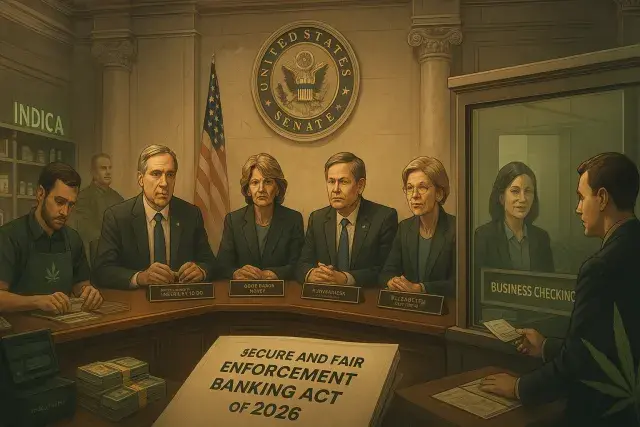
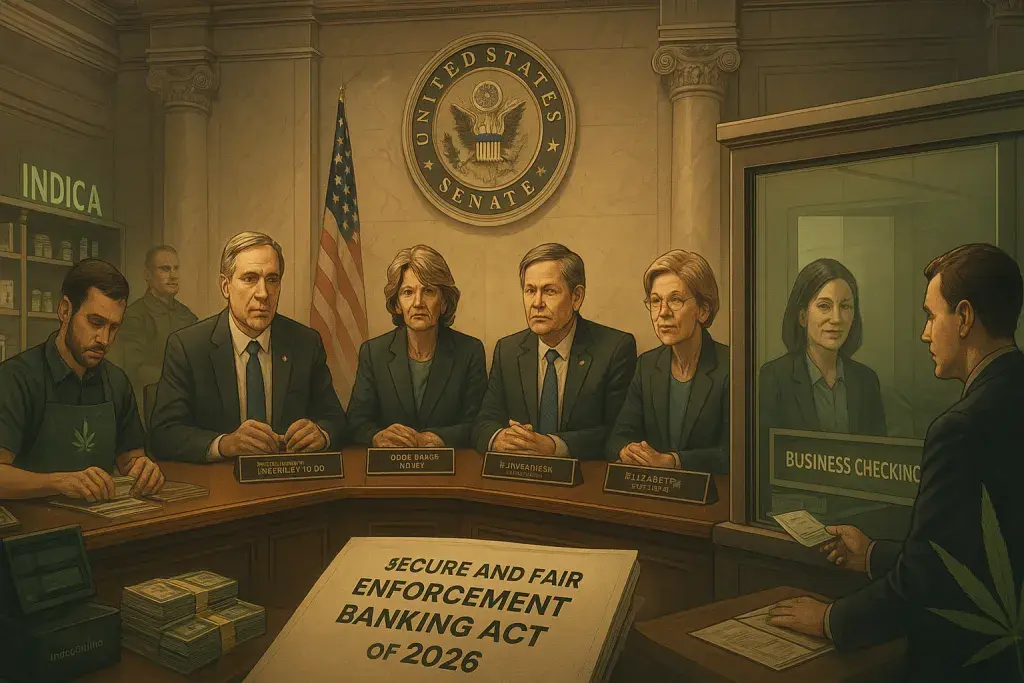
Senator Jeff Merkley (D-OR) re-introduced the Secure and Fair Enforcement (SAFE) Banking Act of 2026 last week, backed by a bipartisan group that includes Senators Lisa Murkowski (R-AK), Steve Daines (R-MT), and Elizabeth Warren (D-MA). The bill would establish a federal safe harbor allowing banks and credit unions to serve state-licensed cannabis businesses without fear of criminal prosecution or asset forfeiture. For dispensary operators, wholesalers, and cannabis-adjacent service providers - think landlords, attorneys, and accountants - that matters enormously. Right now, the absence of federal banking access forces too many of them to run all-cash operations, which creates real public safety exposure and compounds nearly every other operational challenge in the business.
The persistent cash-dependency problem isn't new to anyone running a licensed retail cannabis operation. Without access to standard business checking accounts, merchant services, or commercial credit lines, operators carry enormous sums of physical currency - exposing employees, customers, and neighborhoods to elevated theft risk. For dispensary operators in states like Oregon and Colorado who rely on compliant point-of-sale infrastructure, tools like IndicaOnline POS Colorado help track inventory and transactions precisely, but even the most robust seed-to-sale system can't offset the downstream friction created when a business can't deposit its revenue into a bank account at the end of the day. Cash management, armored transport, and check-cashing fees collectively chip away at already-thin margins.
The SAFE Banking Act, if passed, would prohibit federal regulators from penalizing or discouraging banks from offering services to state-sanctioned cannabis businesses. It would also extend protections to ancillary businesses that work with licensed operators - a provision that matters to the accountants, landlords, and law firms currently reluctant to engage the cannabis sector precisely because their own banks might flag or terminate those accounts. The American Bankers Association has publicly supported the bill, and the Cannabis Industry Association of Oregon is on record backing it as well. That kind of institutional alignment isn't nothing.
Seven House Passes, Senate Still the Obstacle
Here's the catch: the House has passed versions of the SAFE Banking Act seven times with bipartisan support, and it has stalled in the Senate each time. The legislation isn't failing on merits; it's failing on legislative priority and political sequencing. Cannabis banking reform exists in a complicated space - federal drug scheduling, financial regulatory jurisdiction, and state-federal legal conflicts all intersect here, and any one of those threads can snag the bill.
Cannabis was recently rescheduled from Schedule I to Schedule III under federal law, following a process initiated by the Biden administration and accelerated by an executive order from President Trump. That shift acknowledges a reduced dependence potential for the drug. But rescheduling alone doesn't resolve the banking problem. Cannabis remains a controlled substance at the federal level, which means banks operating under federal charters still face legal ambiguity - and in compliance-driven institutions, ambiguity tends to produce inaction.
Beau Whitney of Whitney Economics offered a pointed assessment of the bill's practical limits. In theory, a federal safe harbor de-risks banks from liabilities tied to serving Schedule I or Schedule III operators, increases competition among financial institutions for cannabis accounts, and drives down interest rates and the cost of capital. That last point is particularly meaningful for smaller operators - they carry higher risk profiles due to their size and lack of access to the commercial financing that larger multi-state operators can access through private equity or institutional investors. Lower cost of capital improves the odds of profitability for smaller licensees. That's the theory.
The practice, Whitney warned, depends entirely on implementation. How the rules are written, which operator categories qualify, and whether banks actually enter the market given ongoing legislative volatility - all of that remains unresolved. He pointed to hemp as instructive: hemp is federally legal, yet banking access for hemp operators remains inconsistent because regulatory uncertainty persists around the category. Legal status and accessible banking are not the same thing.
Oregon's Specific Complications
Oregon presents its own wrinkles. Whitney flagged a state-level dynamic worth watching: under current Oregon rules, a cannabis licensee with unpaid tax obligations can't renew their OLCC license. That kind of regulatory exposure may give banks pause even if a federal safe harbor exists - because the underlying business risk hasn't disappeared, it's just been reframed. A bank evaluating a cannabis operator account isn't just thinking about federal safe harbor provisions; it's running credit analysis, assessing state regulatory stability, and asking whether the operator's license is in good standing.
Then there's the profitability question. Whitney's observation that many cannabis companies are not currently profitable - due in part to regulatory supply saturation - cuts to a basic lending reality: banks don't extend services to businesses that can't demonstrate financial viability. Safe harbor from federal prosecution doesn't make an underwater balance sheet more attractive. Operators who have been struggling under Oregon's oversupplied wholesale market, compressed retail pricing, and heavy 280E-adjacent tax exposure won't automatically become bankable customers just because the legal framework changes.
What Operators Should Actually Watch For
The bill's passage is not guaranteed. Congressman David Joyce (R-OH) is carrying the House version, and the bipartisan sponsor list is meaningful - but Senate arithmetic is its own obstacle course. Operators shouldn't plan around the SAFE Banking Act passing in any particular timeframe.
That said, if it does pass, the operational implications are real. Access to business banking accounts, debit and credit merchant services, commercial insurance, and traditional lending would reduce the friction and cost embedded in cash-heavy dispensary operations. It would also open doors for ancillary vendors - payroll processors, real estate partners, technology providers - that currently maintain arm's-length relationships with cannabis clients because of their own institutional banking exposure.
What the SAFE Banking Act won't do, as Whitney put it plainly, is serve as a standalone fix. Banking reform is one component of a broader set of changes - including sensible tax treatment, regulatory rationalization at the state level, and supply chain stabilization - that the cannabis industry needs before institutional capital moves in at scale. The bill matters. It's just not the whole answer.