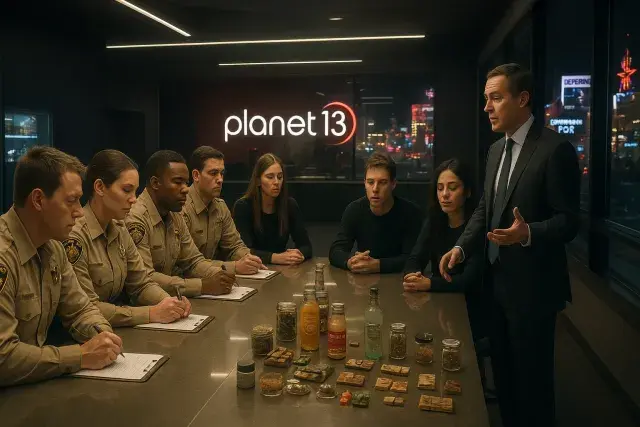
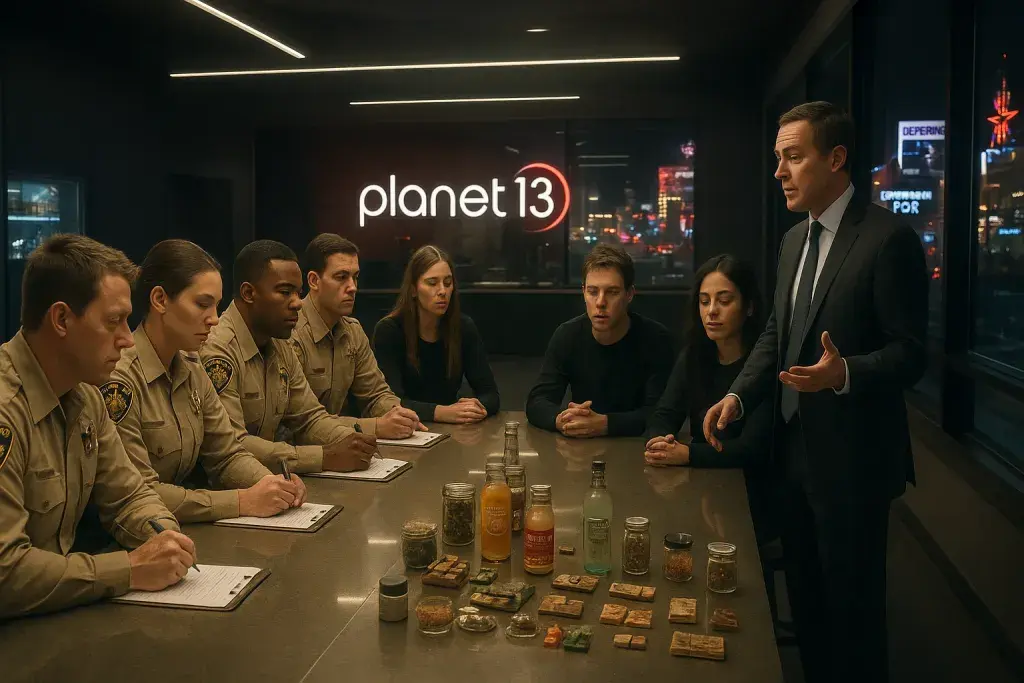
Las Vegas Metropolitan Police Department has formalized a working relationship with Planet 13, one of the country's largest cannabis dispensary and entertainment complexes, to run what law enforcement calls a "Green Lab" - a hands-on training session where officers observe and evaluate volunteers who have consumed cannabis in a controlled, licensed environment. The program is designed to sharpen officers' ability to identify marijuana impairment behind the wheel, a detection challenge that remains one of the more stubborn operational gaps in cannabis-legal states. For the industry, the collaboration signals something the regulated market has long needed: a dispensary operator actively closing the public-safety loop rather than waiting for regulators or law enforcement to impose it.
Green Labs are not unique to Nevada - law enforcement agencies have run similar programs in other adult-use states - but the Planet 13 format puts officers directly inside a licensed retail and consumption lounge, exposing them to the full range of THC products currently on legal dispensary shelves. That includes edibles, beverages, concentrates, and infused food products, not just flower. Understanding product diversity matters in the field. An officer who has never seen a THC-infused water bottle or a dab product has a real information gap when roadside indicators don't match a recognizable consumption profile. For operators in other markets tracking compliance training models - including those evaluating dispensary software missouri as Missouri's adult-use market matures - the Planet 13 approach offers a concrete example of how retailer-law enforcement coordination can be structured without compromising either party's responsibilities.
All volunteers in the Planet 13 Green Lab are dispensary employees. Each arranges a designated driver before participating. That operational detail matters - it keeps the program within responsible-retailing parameters and removes any ambiguity about liability. Planet 13 co-CEO Larry Scheffler noted to FOX5 that roughly 80% of the company's customers are tourists who arrive and depart via taxis or rideshares, which shapes how the dispensary already trains its own staff around responsible consumption. The Green Lab, in that context, is an extension of existing in-house protocol, not a departure from it.
What Officers Are Actually Learning - and Why It's Harder Than It Sounds
Marijuana impairment does not present the way alcohol impairment does. There is no roadside equivalent of a breathalyzer for THC; field sobriety tests remain the primary detection tool, and they require officers to know what they are looking for. Lt. Cody Fulwiler of the LVMPD Traffic Bureau described specific physical indicators the training covers: body tremors, eye tremors, swaying, and delayed reaction time. The duration of a cannabis high varies considerably from person to person - a fact that complicates both roadside assessment and any downstream evidentiary process.
Here's the practical problem: impairment that affects reaction time at highway speeds carries serious consequences regardless of the substance involved. Fulwiler's point about traveling at 45 miles per hour - where a delayed stop response can mean a fatal outcome - is not rhetorical. It reflects a genuine gap between what the legal cannabis market permits and what public safety infrastructure has been built to manage. Officers who aren't trained on cannabis-specific impairment indicators are, by definition, less equipped to recognize it. That's not a criticism; it's an infrastructure problem that falls partly on the industry to help solve.
The Compliance and Responsible Retailing Dimension
For dispensary operators and multi-state operators watching this program, the Planet 13 model carries a few practical takeaways. First, consumption lounges - where legally permitted - create a new layer of responsible-retailing obligation. Staff training on impairment recognition, coordination with local law enforcement, and documented protocols around designated transportation are not optional extras in a mature compliance program; they are the baseline. Second, proactive law enforcement engagement is increasingly a differentiator for licensed operators, particularly in markets where regulators are still calibrating oversight frameworks.
Scheffler's framing - that showing law enforcement how the dispensary operates and how staff manages customer safety is mutually beneficial - reflects a commercial reality that serious operators understand. Regulatory goodwill and law enforcement familiarity with your operation are assets. They don't appear on a balance sheet, but they affect licensing renewals, inspection outcomes, and how quickly a compliance issue gets resolved versus escalated. The Green Lab is, among other things, a demonstration that Planet 13 treats public safety as an operational responsibility, not a marketing position.
A Model Worth Watching as Consumption Lounges Expand
Consumption lounges remain legal in a limited number of jurisdictions, and the regulatory frameworks governing them vary considerably. What the Planet 13 program demonstrates is that the licensed industry can build meaningful public-safety infrastructure around legal consumption - without waiting for a mandate. The fact that Green Lab training has already produced at least one documented field outcome, with an officer identifying a medical emergency at a large-scale festival, is worth noting not as a headline but as a compliance data point: training that transfers to real situations works.
For operators building out consumption-lounge models, or for brands and technology vendors whose products reach those environments, the practical question is whether their own compliance programs account for what happens after a customer leaves the premises. That's not a comfortable question. But in a market where impaired-driving enforcement is increasing and public scrutiny of the cannabis industry remains high, it's the one that licensed operators need to be asking themselves.