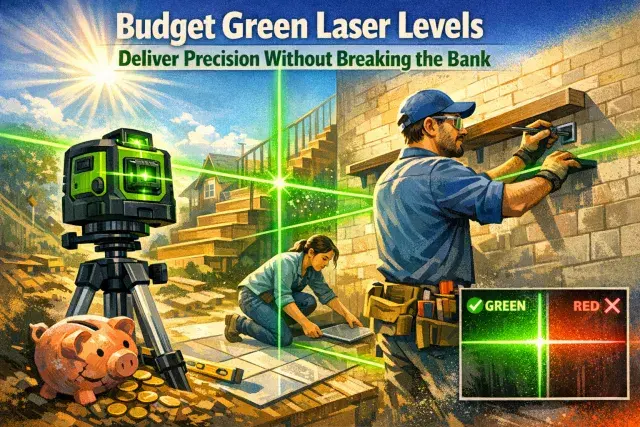
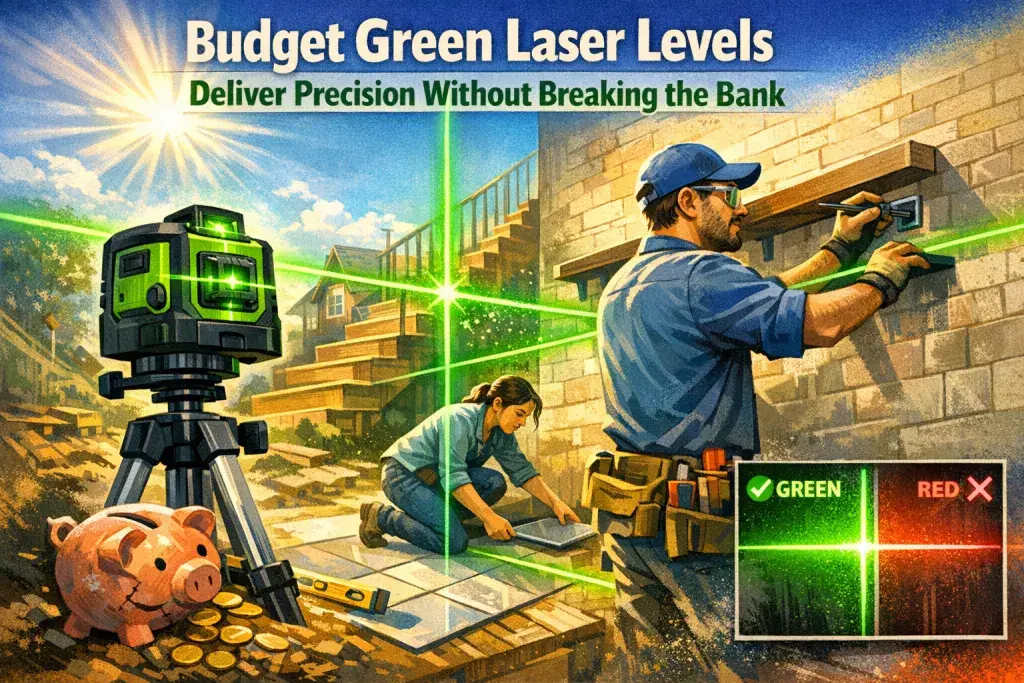
Cheap laser levels often falter in bright light, their red beams fading against sunlight or fluorescents—turning simple jobs like shelf-hanging into guesswork. Green models change that equation; their beams cut through glare four times better, handing DIYers and pros alike reliable sightlines on a shoestring. These tools sidestep the accuracy pitfalls of bargain reds, proving you needn't spend hundreds for lines that hold true.
Why Green Beats Red in Everyday Work
Red lasers dominated early tools because they're cheap to make—standard diodes cost pennies. But human eyes peak in the green spectrum; that's physics, not hype. A green beam registers brighter, especially past 50 feet or under harsh lighting, which explains why budget greens punch above their price. The catch? Early greens drained batteries fast. Modern ones, with efficient diodes, stretch runtime to 10-12 hours—enough for a weekend reno.
Take alignment tasks: tiles demand ±1/9-inch precision at 33 feet to avoid wavy grout lines; cabinets need cross-lines that don't ghost in afternoon sun. Reds blur there. Greens hold sharp, self-leveling within 4° via pendulum mechanisms that flash if tilted beyond. Manual modes unlock sloped work, like stair risers. IP54 seals shrug off dust and splashes; drop ratings to 30 inches mean they survive toolbox tumbles.
Top Picks That Balance Cost and Capability
The Self Leveling Laser Level 100ft pairs vivid green cross-lines with an aluminum tripod—15 to 46 inches adjustable, 360° swivel, 90° tilt. Its 110° angle blankets walls and ceilings; ±1/9-inch accuracy indoors to 100 feet makes it a workhorse for shelves or layouts. Pendulum lock toggles modes smoothly, though lines jiggle briefly post-tripod nudge. Rugged, portable; dust-water resistant. Pros: standout visibility, dual modes, versatile stand. Con: sensitive to minor shifts.
Alloyman 4x360° floods space with full-circle lines—±1mm over 5 meters, Class II safety. Pulse mode stretches to 150 feet outdoors (receiver extra); lithium pack lasts 12 hours. Magnetic mount and remote ease setup for leveling floors or decor. Indoors or out, it trims errors on big jobs. Pros: 360° coverage, outdoor reach, solid battery. Con: no bundled receiver.
Compact Contenders for Quick Jobs
Fanttik D2 slips into a pocket—56 grams, TPE-rubber armored, 360° magnetic pivot. Green cross hits 100 feet indoors, 164 outdoors with pulse (receiver separate); 1/8-inch at 30 feet, 10-hour USB-C charge. Pendulum self-levels fast; lock for angles. Ideal for picture rails or trim—no bulk. Pros: portable punch, all-day power, easy mount. Con: receiver add-on.
Huepar M-9011G greens up cross-lines twice as bright as reds, 110° spread, same ±1/9-inch spec. Soft-grip sheds 2-inch drops; magnetic bracket and 1/4-20 thread fit tripods. AA-powered, pouch-included—novices grab it sans learning curve. Pros: glare-proof beams, mode flexibility, tough shell. Con: magnet grip varies on slick metal.
What Holds Up—and What to Watch
These greens share strengths: visibility that greens out red rivals, self-leveling smarts, modes for flat or funky angles. Tripods and mounts multiply setups; batteries outlast old rechargeables. Shortfalls cluster around extras—receivers apart, occasional bounce. For tight budgets under $50-80, they deliver pro-grade lines without frills. Pick by project: cross for cabinets, 360° for rooms, pocket for grab-and-go. In a field where red still rules low-end shelves, these shift the math—precision no longer demands premium pricing.